23 active research groups are mapped across core, industrial, and applied AI; 103 named publications are cited.
YerevaNN research report
The AI Ecosystem
in Armenia
August 2026
A public, mobile-friendly edition. It distinguishes verified current activity from announcements and planned activity.
Executive Summary
Armenia at a glance
112 organizations are profiled across AI products, consulting and services, and internal AI teams.
Available 2026 admissions data cover 487 Generation AI admissions, 460 undergraduate admissions, and 88 master's admissions.
Snapshot: August 2026
Armenia has a small but substantive AI ecosystem. It combines active academic and industrial research groups, a varied product and services sector, multi-year AI education in public high schools, university and non-degree technical programs, a dense community centered in Yerevan, and a rapidly expanding base of local GPU infrastructure. These components are real, but they differ greatly in scale, maturity, and the strength of the public evidence behind them.
Armenia at a glance #
| Dimension | Current picture |
|---|---|
| Research | 23 active research groups are mapped across core, industrial, and applied AI; 103 named publications are cited. |
| Industry | 112 organizations are profiled across AI products, consulting and services, and internal AI teams. |
| Education | Available 2026 admissions data cover 487 Generation AI admissions, 460 undergraduate admissions, and 88 master's admissions across programs with usable data. |
| Compute | YSU, Eleveight AI, and Firebird operate 6,736 publicly documented data-center GPUs as of August 2026. |
| Government | The government funds AI research and public compute, coordinates school integration, subsidizes access to commercial infrastructure, supports industry, and is beginning to deploy and govern AI in public services. |
| Community and literacy | Recurring conferences, reading groups, meetups, summer schools, and specialist online groups connect researchers and practitioners. AI literacy is about learning to use AI tools, not developing AI systems. |
Principal findings #
1. Demonstrated research capacity exists, but it is concentrated. Armenia has identifiable research groups and internationally visible outputs, including both core AI research and AI-enabled work in other scientific fields. The number of stable groups and experienced supervisors remains limited. 2. The commercial landscape is broader than the research landscape. Many companies build AI products or provide AI services, but only a smaller subset has verifiable public research outputs. The report therefore separates business model, technical approach, and public research activity. 3. Education has developed recognizable pathways. School programs, university degrees, professional training, and research-oriented enrichment now form several routes into AI. Outcome reporting, doctoral specialization, and advanced supervision remain uneven. 4. Armenia is moving from GPU scarcity to an infrastructure build-out. Public, private, and commercial platforms now offer distinct access routes. Announced capacity should not be treated as operational capacity, and local benefit depends on transparent allocation, affordability, support, and measurable outputs. 5. The ecosystem is connected but institutionally fragmented. Community organizations and recurring events create strong informal links, while evidence, access rules, program outcomes, and current capacity remain scattered across institutions.
Throughout the report, current operations are separated from announced plans, core AI research from the use of AI in another field, and public evidence from unverified claims. The result is an evidence-based overview rather than a promotional ranking, national strategy, or policy proposal.
AI Research
Status: Release candidate Evidence checked: August 2026
This chapter maps organizations in Armenia that publicly conduct research using machine learning or AI. It distinguishes three parts of the ecosystem:
- Academic AI research groups: university and nonprofit groups for which AI methods, models, datasets, or benchmarks are a central research purpose. These include the YSU Machine Learning Research Group / YerevaNN, CAST's Machine Learning Research Group at RAU, the YSU Artificial Intelligence Laboratory, the AUA/FAST ADVANCE Data-science Research Group, AUA Computer Vision and Medical Imaging Research, the Mathematical Modeling & Machine Learning Laboratory at the NAS RA Institute of Mechanics, and the completed YSU/FAST Computer Vision Research Group.
- Industrial AI research groups: company teams that publish papers or release research outputs such as models, datasets, or benchmarks. The chapter covers Picsart AI Research, NVIDIA Armenia, Metric AI Lab, Deep Origin, Denovo Sciences, Toxometris, ServiceTitan Armenia, and Amaros AI.
- Academic research groups that use AI within another field: groups primarily studying materials, physics, astronomy, mathematics, optics, biology, control, or another domain, with ML as one research method. These include the YSU Computational Materials Science Laboratory and its collaborators at the A.B. Nalbandyan Institute of Chemical Physics, the Division of Quantum Technologies at the A. Alikhanyan National Laboratory, ICRANet-Armenia, scientific-ML researchers at the Institute of Mathematics of NAS RA and YSU, the YSU Photonics and Artificial Intelligence Laboratory, the Center for Scientific Innovation and Education at NPUA, the FAST ADVANCE drug-discovery group hosted by the L.A. Orbeli Institute of Physiology, the Armenian Bioinformatics Institute, and the Institute of Molecular Biology of NAS RA.
Scope #
Groups are included when their AI activity is documented through relevant papers, active research projects, or public models, datasets, and benchmarks. The chapter uses institutional pages, publication records, conference programs, and public research repositories as evidence.
The map is limited to publicly documented affiliations and outputs. Multi-institution and company papers are attributed to their Armenia-based contributors rather than treated as wholly Armenia-based projects.
Academic AI research groups #
YSU Machine Learning Research Group / YerevaNN #
Institution and history. YerevaNN began in 2016 as an independent scientific-educational nonprofit. The research team was later integrated into Yerevan State University as the YSU Machine Learning Research Group, while the YerevaNN Foundation continued to support research, fundraising, and scientific community building. The two names therefore describe one overlapping research group, not two labs.
How the group uses AI. The group's current program has two main directions:
- AI for robotics: learning-based perception from visual, multispectral, radar/SAR, and wireless signals, together with high-level robot control and navigation using vision-language models and vision-language-action approaches.
- AI for molecules: generative and predictive models for two-dimensional molecular structures, three-dimensional conformers, and multi-objective molecular generation and optimization.
Recent AI publications.
Robotics, perception, and control:
- Enhancing Aerial Vision-Language Navigation with Map Grounding and History Awareness, ICLR 2026 ES-Reasoning Workshop.
- GeoCrossBench: Cross-Band Generalization for Remote Sensing, ICLR 2026 ML4RS Workshop; an earlier version appeared at an ICML 2025 workshop.
- HOSS-Bench: Open-Set Cross-Modal Vessel Re-Identification Benchmark, ICLR 2026 ML4RS Workshop, using RGB and synthetic-aperture-radar imagery.
- Bridging the Sim-to-real Gap in RF Localization with Large-Scale Synthetic Pretraining, ICLR 2026 DATA-FM Workshop, following the 2025 Information Fusion paper of the same line.
- Fusion of Pervasive RF Data with Spatial Images via Vision Transformers for Enhanced Mapping in Smart Cities, Pervasive and Mobile Computing, 2026.
- Teaching Visual Language Models to Navigate using Maps, ICLR 2025 Robot Learning Workshop.
Molecular generation and optimization:
- PMO-Dock: Benchmarking Docking, Specificity and Generalization in Molecular Optimization, ICLR 2026 GEM Workshop.
- Accurate Tokenization of 3D Small Organic Molecules, ICLR 2026 FM4Science Workshop; introduces CoordToken for representing 3D molecular conformers.
- Towards Molecular Conformer Generation with Language Models, ICML 2025 FM4LS and GenBio Workshops.
- Towards Scaling Laws for Language Model Powered Evolutionary Algorithms: Case Study on Molecular Optimization, ICLR 2025 GEM Workshop.
- BARTSmiles: Generative Masked Language Models for Molecular Representations, an earlier foundation for the group's molecular-language-model work.
The group also publishes on general ML questions. A recent example is In-context learning in presence of spurious correlations, published in Transactions on Machine Learning Research in 2026.
Funding. More than half of the group's funding comes from Higher Education and Science Committee research grants administered through YSU. The remainder is fundraised by the YerevaNN Foundation from donors and local companies.
CAST Machine Learning Research Group, RAU #
Institution and history. The Center of Advanced Software Technologies (CAST) at the Russian-Armenian University is a broader software-research center covering compilers, program analysis, cloud systems, autonomous systems, robotics, ML, and AI. Its Machine Learning Research Group is led by Karen Avetisyan.
How the group uses AI. The group develops ML methods and applications in speech and language processing for Armenian and other low-resource languages, including LLM benchmarks, as well as adversarial robustness of language models, distributed learning, multimodal emotion recognition, biomedical signal classification, and efficient computer vision.
Selected researchers. Researchers with publicly documented AI work include:
- Karen Avetisyan — lead of the Machine Learning Research Group; natural-language processing, Armenian language technologies, and machine learning.
- Shahane Tigranyan — engineer-programmer at CAST; machine learning, biomedical signals, distributed learning, and multimodal recognition.
- Olga Hovhannisyan — researcher at CAST; machine learning, computer vision, and NLP.
- Vardan Sahakyan — researcher at CAST; machine learning, computer vision, reinforcement learning, control, and robotics.
Recent AI publications. Recent publications include:
- Automatic Speech Recognition for Armenian Dialects, International Journal of Speech Technology, 2026.
- BANT: Byzantine Antidote via Trial Function and Trust Scores, AAAI 2026, on Byzantine-robust distributed machine learning.
- Adversarial Attacks on Language Models: Risks, Methods, and Countermeasures, 2024.
- Bi-dialectal Automatic Speech Recognition for Armenian, SIGUL 2024.
- Cross-lingual plagiarism detection: Two are Better Than One, 2023.
- An Accurate Real-Time Object Tracking Method for Resource-Constrained Devices, 2024.
- Enhancing Image Recognition with Pre-Defined Convolutional Layers Based on PDEs, Programming and Computer Software, 2023; Vardan Sahakyan, with RAU affiliation.
- Comparison of Single Object Tracking Algorithms on Video Sequences Captured from UAV, Vestnik of RAU, 2022; Vardan Sahakyan and Olga Hovhannisyan.
- Comparing and Improving Change Detection Methods, Vestnik of RAU, 2024; Vardan Sahakyan and Olga Hovhannisyan among the RAU-affiliated authors.
Funding. No public breakdown of the ML group's current funding is available.
YSU Artificial Intelligence Laboratory #
Institution and history. This YSU laboratory was founded in 2022 and is headed by Ashot Harutyunyan. It is a separate research group from the YSU Machine Learning Research Group / YerevaNN.
How the group uses AI. Its recent work develops interpretable and uncertainty-aware machine-learning methods, including classifiers and clustering methods based on Dempster-Shafer theory.
Recent AI publications. Recent outputs associated with Ashot Harutyunyan and collaborators include:
- DSGD++: Reducing Uncertainty and Training Time in the DSGD Classifier through a Mass Assignment Function Initialization Technique, Journal of Universal Computer Science, 2025.
Funding. YSU, state grants, and industry collaborations.
AUA/FAST ADVANCE Data-science Research Group #
Institution and history. This research group was established through FAST's ADVANCE program, hosted and co-implemented by the American University of Armenia, and remotely supervised by Nelson Baloian of the University of Chile. Ashot Harutyunyan and Arnak Poghosyan were the senior local researchers; the team also included junior researchers and research interns. After ADVANCE funding ended, substantially the same team continued its research and publications.
How the group uses AI. The group develops interpretable and robust machine-learning methods for ill-structured data, with applications to automated diagnosis, root-cause analysis, incident discovery, intelligent trace sampling, and knowledge retrieval in complex cloud systems.
Recent AI publications.
- Explaining Performance Issues of Cloud Applications From Logs Using Rule Induction and Dempster-Shafer Theory, IEEE Access, 2026.
- Interpretable Clustering Using Dempster-Shafer Theory, Journal of Universal Computer Science, 2025.
- A Study on Automated Problem Troubleshooting in Cloud Environments with Rule Induction and Verification, Applied Sciences, 2024.
- Discovery of Cloud Applications from Logs, Future Internet, 2024.
- The Diagnosis-Effective Sampling of Application Traces, Applied Sciences, 2024.
- Knowledge Retrieval and Diagnostics in Cloud Services with Large Language Models, Expert Systems with Applications, 2024.
- Optimizing SaaS Solutions for Enhanced Sustainability and Predictive Management of Cloud Assets, AICCC 2023 proceedings, published 2024.
- Discovery of Cloud Incidents Through Streaming Consolidation of Events Across Timeline and Topology Hierarchy, IEEE/IFIP NOMS 2024.
- An Empirical Analysis of Feature Engineering for Dempster-Shafer Classifier as a Rule Validator, CODASSCA 2024.
- An Explainable Clustering Algorithm Using Dempster-Shafer Theory, CODASSCA 2024.
- Challenges and Experiences in Designing Interpretable KPI-diagnostics for Cloud Applications, Journal of Universal Computer Science, 2023.
- Distributed Tracing for Troubleshooting of Native Cloud Applications via Rule-Induction Systems, Journal of Universal Computer Science, 2023.
Funding. FAST's ADVANCE program funded the group and lists AUA as its co-funding and co-implementing institution. The group's current funding is not publicly itemized.
AUA Computer Vision and Medical Imaging Research #
Institution and organization. This activity is centered on AUA researchers and projects rather than a single institution-wide AI laboratory. Researchers including Varduhi Yeghiazaryan develop computer-vision methods for biomedical and hyperspectral imaging.
How the group uses AI. The research develops segmentation, super-resolution, classification, and learning methods for hyperspectral and medical images. AUA's Engineering Research Center project list documents a broader collection of related AI projects.
Recent AI publications. Recent publications include:
- PLESS: Pseudo-Label Enhancement with Spreading Scribbles for Weakly Supervised Segmentation, 2026 preprint.
- Joint Super-Resolution and Spectral Reconstruction via Linear Initialization of a Pretrained RGB Model, ICASSP 2026.
- Comparative Analysis of Deep Learning Methods for Classification of Ablated Regions in Hyperspectral Images of Atrial Tissue, IEEE Access, 2025.
- Combining 4D Hyperspectral Imaging With CNN for Nerve and Ligament Differentiation, ISBI 2025.
Funding. Project-specific university and grant support includes the Afeyan Family Foundation Research Grant, which AUA reports supported an ICIP 2025 hyperspectral-imaging paper.
Mathematical Modeling & Machine Learning Laboratory, Institute of Mechanics of NAS RA #
Institution and history. The Mathematical Modeling & Machine Learning Laboratory (M3L) was established in June 2025 at the Institute of Mechanics of NAS RA and is led by Davit Piliposyan. It brings together researchers from the institute, YSU, IIAP, and industry.
How the group uses AI. M3L works at the intersection of machine learning and computational mechanics. Its program includes physics-informed learning and differentiable finite-element methods, 3D scene understanding, event-sequence representations, and agentic systems for retrieval, simulation, and optimization workflows.
Recent AI publication. Z3D: Zero-Shot 3D Visual Grounding from Images, ACL 2026, introduces a pipeline for localizing objects described in natural language within 3D scenes using multi-view images and vision-language models.
Funding. No public breakdown of the laboratory's current funding is available.
YSU/FAST Computer Vision Research Group #
Institution and history. The Yerevan-based computer-vision group began with Hrach Ayunts, Hayk Gasparyan, and Sargis Hovhannisyan under the remote supervision of Sos Agaian through FAST's ADVANCE program. Hrach Ayunts subsequently became a local supervisor and, after defending his PhD, joined Yerevan State University's Faculty of Applied Mathematics and Informatics. The group continued its research after ADVANCE funding ended, supported through Armenia's state research-funding system.
How the group uses AI. The group developed deep-learning methods for robust visual perception, particularly visible and thermal image enhancement, object detection in adverse weather, multispectral and hyperspectral reconstruction, remote-sensing segmentation, and solar-panel fault detection.
Recent AI publications. Relevant outputs include:
- Robust Perception in Degraded Visual Environments: A Multimodal Enhancement Framework, Pattern Recognition and Image Analysis, published online in 2026; the article records support from YSU and FAST ADVANCE.
- Thermal Video Enhancement Mamba: A Novel Approach to Thermal Video Enhancement for Real-World Applications, Information, 2025.
- A New Method for Judging Thermal Image Quality with Applications, Signal Processing, 2025.
- Efficient Lightweight Networks for Solar Panel Fault Classification Using EL and RGB Imagery, IEEE Transactions on Instrumentation and Measurement, 2025.
- EOD-Net: Enhancing Object Detection in Challenging Weather Conditions Using an Innovative End-to-End Dehazing Network, IPTA 2023.
- Fourier Multispectral Transformer for Robust Hyperspectral Reconstruction and Remote Sensing Segmentation, Pattern Recognition and Image Analysis, 2026.
Funding. The original collaboration was funded through FAST's ADVANCE program. After the ADVANCE grant ended, the group's research continued with state funding.
FAST's Machine Learning project, co-implemented with YSU and led by Arnak Dalalyan, operated from 2020 to 2024 and produced five publications on robust estimation, feature matching under noise and outliers, and generative modeling, including papers at AISTATS 2023 and ICML 2024. The group included Arshak Minasyan, now at CentraleSupélec in France; Tigran Galstyan, who recently joined NVIDIA Armenia; and Sona Hunanyan, who returned from Switzerland to join the project and now works at Philip Morris International.
Industrial AI research groups #
Industrial AI research groups are funded by their respective companies; company-level research budgets are generally not disclosed. Since 2025, Armenian resident companies have also been able to seek formal qualification of research projects as R&D under a national tax-incentive scheme. The Ministry of High-Tech Industry publishes the application guidance, while an interagency expert commission evaluates whether projects meet the qualification criteria. According to the Ministry's overview of the scheme, qualifying activity is eligible for deductions in calculating profit tax and for depreciation deductions, while eligible employees performing professional R&D work are subject to a 10% income-tax rate.
Picsart AI Research (PAIR) #
Institution and history. Picsart maintains a company research program commonly presented as Picsart AI Research or PAIR. Armenia-based contributors include Shant Navasardyan, Levon Khachatryan, and Barsegh Atanyan. Its public research page and Hugging Face paper collection document its scientific output.
How the group uses AI. PAIR develops generative and discriminative computer-vision models for image and video creation, editing, inpainting, segmentation, and controllable diffusion.
Recent AI publications. Examples include:
- FlowDIS: Language-Guided Dichotomous Image Segmentation with Flow Matching, CVPR 2026, by Andranik Sargsyan and Shant Navasardyan.
- Beyond Realism: Learning the Art of Expressive Composition with StickerNet, WACV 2026.
- StreamingT2V: Consistent, Dynamic, and Extendable Long Video Generation from Text, CVPR 2025, with Shant Navasardyan.
- HD-Painter: High-Resolution and Prompt-Faithful Text-Guided Image Inpainting with Diffusion Models, ICLR 2025, with Shant Navasardyan.
- Zero-Painter: Training-Free Layout Control for Text-to-Image Synthesis, CVPR 2024, with Shant Navasardyan.
- Grounded-Instruct-Pix2Pix: Improving Instruction-Based Image Editing with Automatic Target Grounding, ICASSP 2024.
- Specialist Diffusion: Plug-and-Play Sample-Efficient Fine-Tuning of Text-to-Image Diffusion Models To Learn Any Unseen Style, CVPR 2023, with Shant Navasardyan.
NVIDIA Armenia research team #
Organization. NVIDIA's Armenia research team contributes primarily to the company's international research programs in language models and speech. The report does not identify a dedicated NVIDIA robotics operation in Armenia.
Publishing researchers based in Armenia. Erik Arakelyan, Edgar Minasyan, Rima Shahbazyan, Ivan Moshkov, Daria Gitman, Alexan Ayrapetyan, Sofia Kostandian, Nune Tadevosyan, George Zelenfroynd, Aleksei Karmanov, Aigul Dzhumamuratova, Viktor Kuznetsov, Lilit Grigoryan, Vladimir Bataev, Andrei Andrusenko, and Davit Karamyan.
Former Armenia-based publishing researchers. Nikolay Karpov was part of the Armenia team through 2025. Monica Sekoyan's 2025 Granary paper lists her with an NVIDIA Armenia affiliation; she is now based in Edinburgh. Aleksandr Laptev published NVIDIA speech-recognition work while based in Armenia in 2022 and is now based in California.
How they use AI. Their recent publications cover language-model reasoning and robustness, NVIDIA Nemotron model development, speech recognition and translation, diarization, and simultaneous speech translation. A 2025 visual-odometry paper has Armenia-based co-authors, but this publication alone is not treated as evidence of a local robotics team.
Reverse brain drain. NVIDIA Armenia provides a local research environment for researchers who trained and established publication records at leading universities abroad to continue their careers in Armenia. Erik Arakelyan moved to Armenia after completing his PhD at the University of Copenhagen. Edgar Minasyan similarly moved to Armenia after completing his PhD at Princeton University. Their subsequent relocation illustrates the team's role in attracting internationally trained researchers to Armenia.
Recent AI publications. Examples include:
- L0-Reasoning Bench: Evaluating Procedural Correctness in Language Models via Simple Program Execution, 2025, an NVIDIA paper with Erik Arakelyan.
- OpenMathInstruct-1: A 1.8 Million Math Instruction Tuning Dataset, NeurIPS 2024, with Ivan Moshkov and Daria Gitman.
- OpenMathInstruct-2: Accelerating AI for Math with Massive Open-Source Instruction Data, ICLR 2025, with Ivan Moshkov and Alexan Ayrapetyan.
- NVIDIA Nemotron 3: Efficient and Open Intelligence and Nemotron-Math, 2025-2026 technical reports with Edgar Minasyan; the Nemotron 3 report also includes Rima Shahbazyan, Ivan Moshkov, and Daria Gitman.
- NVIDIA Nemotron Nano 2: An Accurate and Efficient Hybrid Mamba-Transformer Reasoning Model, 2025, with Rima Shahbazyan.
- Evaluating Robustness in Latent Diffusion Models via Embedding Level Augmentation, 2025, with Aleksei Karmanov.
- Methods to Increase the Amount of Data for Speech Recognition for Low Resource Languages, 2025, with Alexan Ayrapetyan, Sofia Kostandian, Nune Tadevosyan, and Nikolay Karpov.
- Granary: Speech Recognition and Translation Dataset in 25 European Languages, Interspeech 2025, with Monica Sekoyan, George Zelenfroynd, Sofia Kostandian, and Nikolay Karpov under the paper's NVIDIA Armenia affiliation.
- FlexCTC: GPU-powered CTC Beam Decoding With Advanced Contextual Abilities and TurboBias: Universal ASR Context-Biasing Through Adaptive Subword Encodings and GPU-Accelerated Decoding, 2025, with Yerevan-based authors including Lilit Grigoryan, Vladimir Bataev, Andrei Andrusenko, and Nikolay Karpov.
- The CHiME-7 Challenge: System Description and Performance of NeMo Team's DASR System, 2023, with Nikolay Karpov.
- NeMo@IWSLT 2026: Cascaded System for Simultaneous Speech Translation, with Yerevan-based researchers Lilit Grigoryan, Vladimir Bataev, Andrei Andrusenko, and Davit Karamyan; Nikolay Karpov, who was part of the Armenia team through 2025, is also a co-author.
- cuVSLAM: CUDA Accelerated Visual Odometry and Mapping, 2025, with Armenia-based co-authors Aigul Dzhumamuratova and Viktor Kuznetsov.
- Fast Entropy-Based Methods of Word-Level Confidence Estimation for End-To-End Automatic Speech Recognition, 2022, with then-Armenia-based NVIDIA researcher Aleksandr Laptev.
Metric AI Lab #
Institution and history. Metric AI presents itself as an Armenia-based research lab focused on language technologies. Its public Hugging Face organization lists team members and releases.
How the group uses AI. The lab lists three programs: physical AI, including spatial reasoning and long-horizon robot planning; text-embedding models and evaluation for Armenian and other low-resource languages; and visual-document retrieval. The physical-AI program is presented as its current primary focus, while the document-retrieval line is described as past work.
Recent AI publications and outputs. Public work includes:
- Less is More: Adapting Text Embeddings for Low-Resource Languages with Small Scale Noisy Synthetic Data, LoResLM 2026.
- ArmBench-LLM, a benchmark for evaluating language models on Armenian tasks.
- ATE-2, a family of Armenian text-embedding models released together with the ArmBench-TextEmbed benchmark, including public base and large checkpoints.
- JEPA for Long-Horizon Robotic Planning, listed by the lab as under review at NeurIPS 2026.
Deep Origin #
Organization. Armenia-based Deep Origin researchers with recent publications include Tsolak Ghukasyan, Vahagn Altunyan, Aram Bughdaryan, Tigran Aghajanyan, Khachik Smbatyan, and Garik Petrosyan.
How they use AI. Public work combines large-language-model agents for drug-discovery workflows, active learning and graph neural networks for molecular-property prediction and quantum-chemistry dataset construction, and hybrid machine-learning and physics-based methods for molecular docking and virtual screening.
Recent AI publications.
- Overcoming the accuracy-generalization tradeoff in docking and scoring for prospective virtual screening, bioRxiv preprint, 2026. The paper introduces DODock and DOScore, hybrid ML-and-physics systems for predicting protein-ligand binding poses and ranking compounds. It reports prospective screening results across four therapeutic targets, including a 30.6% experimental hit rate for CD73 and a blind PCSK9 binding-pose prediction later confirmed by crystallography.
- A bivalent molecular glue linking lysine acetyltransferases to oncogene-induced cell death, Cell, 2026. Deep Origin researchers Artur Hakobyan, Vahram Arakelov, Garik Petrosyan, and Aram Davtyan contributed molecular docking, molecular-dynamics simulations, and quantum-mechanical calculations that helped explain the activity of the lead compound against diffuse large B-cell lymphoma.
- Smart distributed data factory volunteer computing platform for active learning-driven molecular data acquisition, Scientific Reports, 2025. The work introduces an active-learning platform that uses ensembles of graph neural networks to select molecular conformations for distributed quantum-chemistry calculations and releases a dataset of more than two million conformations with DFT-calculated energies.
- Can AI Agents Design and Implement Drug Discovery Pipelines?, 2025, introduces the DO Challenge benchmark and the Deep Thought multi-agent system.
Denovo Sciences #
Organization. Denovo Sciences is an Armenia-founded, research-driven drug-discovery company with a scientific and engineering team in Yerevan. Its public research page documents its publications and research resources.
How it uses AI. Denovo develops generative and predictive methods for small-molecule drug discovery. Its platform combines deep reinforcement learning, molecular modeling, virtual screening, and machine-learning-based assessment to generate and prioritize drug candidates.
AI and computational drug-discovery publications.
- Multi-target Computational Pipeline for Discovery of Pan-influenza Neuraminidase Inhibitors, Frontiers in Pharmacology, 2026.
- Can Artificial Intelligence Transform Antiviral Drug Discovery?, Drug Discovery Today, 2026.
- Machine Learning-Based Soft Voting Ensemble Model for the Prediction of Oral Drug-Likeness of Chemical Structures, Journal of Chemical Information and Modeling, 2026; introduces the HADES drug-likeness model.
- Data-driven Discovery of Chemical Signatures for Developing New Inhibitors Against Human Influenza Viruses, Journal of Cheminformatics, 2025.
- Discovery of New Antiviral Agents Through Artificial Intelligence: In Vitro and In Vivo Results, Antiviral Research, 2024.
- Computational Evaluation and Benchmark Study of 342 Crystallographic Holo-structures of SARS-CoV-2 Mpro Enzyme, Scientific Reports, 2024.
- Targeting SARS-CoV-2 Main Protease: A Comprehensive Approach Using Advanced Virtual Screening, Molecular Dynamics, and In Vitro Validation, Virology Journal, 2024.
Toxometris #
Organization. Toxometris conducts Armenia-linked research in computational toxicology and molecular ML. Its publications include researchers Zaven Navoyan, Ani Tevosyan, Nelly Babayan, Lusine Khondkaryan, Hayk Navasardyan, Gohar Tadevosyan, and Lilit Apresyan, with collaborations involving YerevaNN, YSU, and the Institute of Molecular Biology of NAS RA.
How it uses AI. Its research covers learned molecular representations, QSAR modeling with molecular descriptors and fingerprints, graph neural networks, language models, boosting ensembles, and consensus models for toxicity, carcinogenicity, and molecular-property prediction.
Collaboration with IMB and YerevaNN. Toxometris, the Institute of Molecular Biology of NAS RA, and YerevaNN have an established collaboration connecting biological and toxicological expertise with ML model development. Their joint publications include:
- Improving VAE based molecular representations for compound property prediction, Journal of Cheminformatics, 2022.
- Datasets Construction and Development of QSAR Models for Predicting Micronucleus In Vitro and In Vivo Assay Outcomes, Toxics, 2023.
- BARTSmiles: Generative Masked Language Models for Molecular Representations, Journal of Chemical Information and Modeling, 2024.
Other AI publications and applications.
- AI/ML Modeling to Enhance the Capability of In Vitro and In Vivo Tests in Predicting Human Carcinogenicity, Mutation Research/Genetic Toxicology and Environmental Mutagenesis, 2025.
- Consensus Modeling Strategies for Predicting Transthyretin Binding Affinity from Tox24 Challenge Data, Chemical Research in Toxicology, 2025.
- Synthesis, in silico, and in vitro pharmacological evaluation of norbornenylpiperazine derivatives as potential ligands for nuclear hormone receptors, Journal of Applied Pharmaceutical Science, 2025. The study applies Toxometris models to ADMET and toxicity prediction for the synthesized compounds.
- Enhancing Chemical-Induced Human Carcinogenic Risk Evaluation through Advanced AI Technologies, Proceedings, 2024.
- Predictive, integrative, and regulatory aspects of AI-driven computational toxicology—Highlights of the German Pharm-Tox Summit (GPTS) 2024, Toxicology, 2024. This review and conference report covers Toxometris's AI-driven computational-toxicology work alongside developments from other groups.
ServiceTitan Armenia #
Organization. ServiceTitan's Yerevan office conducts applied AI work and supports a multi-year research collaboration with the American University of Armenia. Arman Zakaryan, Director of AI Engineering at ServiceTitan Armenia, has represented the company in the collaboration, while AUA researchers Habet Madoyan and Aram Butavyan have led the university teams.
How it uses AI. Public research covers visual document retrieval and RAG, natural-language processing for matching duplicate catalog items, conversational job scoping, retrieval of similar historical cases, price estimation, and automated sales-estimate preparation.
Recent AI publication and research projects.
- Visual RAG at Scale: Tile-Level Spatial Pooling for Efficient Multi-Vector Document Retrieval, SIGIR 2026 Demo Track, by Ara Yeroyan of ServiceTitan. The system reduces the storage and retrieval cost of multi-vector visual document embeddings through spatial pooling and two-stage retrieval without model retraining.
- ServiceTitan's first completed AUA collaborative research project developed an NLP pipeline for identifying duplicate products across more than 10,000 customer catalogs.
- The current ServiceTitan–AUA research program develops ML models for job scoping and price estimation, including conversational clarification, retrieval of comparable past jobs, and generation of estimates and proposals.
Amaros AI #
Organization. Davit Shahnazaryan is associated with Amaros AI and YSU.
How it uses AI. The published work applies large language models to extract biomedical entities and relations and construct medical knowledge graphs from electronic medical records.
Recent AI publication. Large Language Models for Biomedical Knowledge Graph Construction: Information extraction from EMR notes, 2023.
Academic research groups that use AI within another field #
YSU Computational Materials Science Laboratory #
Primary field. Computational materials science.
How it uses AI. The laboratory uses ML to search chemical and materials spaces, predict material properties, and accelerate candidate discovery. YSU explicitly describes this role in its laboratory overview.
Relevant AI work. A 2025 interdisciplinary project, Detection of Superconducting Materials at Room Temperature and Atmospheric Pressure Conditions Using Chemistry-Informed Neural Networks, combines materials data with chemistry-informed neural models. The laboratory also collaborates with the Functional Materials Group at the A.B. Nalbandyan Institute of Chemical Physics on ML-guided materials discovery. Recent joint and institute-led outputs include:
- Accelerated composition optimization of hybrid perovskites via data-driven materials design, DFT calculations and synthesis, Materials & Design, 2025. Random-forest and gradient-boosting models screen candidate perovskite compositions, followed by DFT and experimental validation.
- Finding Perovskite Composites With Preferable Features: Simple ML algorithms, AI4X 2025 Oral, by Gurgen Kolotyan, Arevik Asatryan, and Hayk Khachatryan of the A.B. Nalbandyan Institute of Chemical Physics.
Funding. The projects receive university and state research support. The AI4X work acknowledges Higher Education and Science Committee grant 22RL-012; a consolidated current breakdown is not public.
Division of Quantum Technologies, A. Alikhanyan National Laboratory #
Primary field. Theoretical and statistical physics, quantum technologies, and decision theory.
Organization. The Division of Quantum Technologies grew from a research group formed around 2015 and became a formal AANL division in 2022. Armen Allahverdyan leads the group; its researchers include Arshak Hovhannisyan.
How it uses AI. One line of the division's work studies causal and probabilistic inference: how hidden common causes can be recovered from observed distributions, how such representations relate to nonnegative matrix factorization, and how they can support reliable decisions in cases such as Simpson's paradox.
Relevant AI publications.
- Resolution of Simpson's paradox via the common cause principle, NeurIPS 2025, by Arshak Hovhannisyan and Armen Allahverdyan. The paper develops a latent-common-cause account of Simpson's paradox for discrete and Gaussian settings and studies its implications for probabilistic inference and decision-making.
- Nonnegative Matrix Factorization and the Principle of the Common Cause, IEEE DSAA 2025, by Edvard Khalafyan, Armen Allahverdyan, and Arshak Hovhannisyan.
- The most likely common cause, International Journal of Approximate Reasoning, 2024, on identifying latent common causes using generalized maximum likelihood.
Funding. The recent common-cause research acknowledges Armenian Science Committee grants, including 20TTAT-QTa003 and 21AG-1C038. The division also lists institutional and external project support; a consolidated current breakdown is not public.
ICRANet-Armenia astrophysics research #
Primary field. High-energy astrophysics and multiwavelength astronomy.
How it uses AI. ICRANet-Armenia researchers use gradient-boosted trees and neural networks to classify gamma-ray sources. They also train convolutional-neural-network surrogate models that reproduce computationally expensive physical simulations of blazar emission, enabling faster parameter estimation and fitting of observational data.
Relevant AI publications.
- Gradient boosting decision trees classification of blazars of uncertain type in the fourth Fermi-LAT catalogue, Monthly Notices of the Royal Astronomical Society, 2023, by Narek Sahakyan, Vahe Vardanyan, and Mher Khachatryan of ICRANet-Armenia.
- Modeling Blazar Broadband Emission with a Convolutional Neural Network. I. Synchrotron Self-Compton Model, The Astrophysical Journal, 2024, with ICRANet-Armenia researchers Narek Sahakyan, Samvel Gasparyan, and Mher Khachatryan.
- Modeling Blazar Broadband Emission with Convolutional Neural Networks. II. External Compton Model, The Astrophysical Journal, 2024, with ICRANet-Armenia researchers Narek Sahakyan, Samvel Gasparyan, Vahe Vardanyan, and Mher Khachatryan.
Funding. The 2024 external-Compton study acknowledges Higher Education and Science Committee research project 23LCG-1C004 for the Armenia-based contributors.
Institute of Mathematics of NAS RA and YSU scientific machine learning research #
Primary field. Numerical analysis, partial differential equations, free-boundary problems, and mathematical modeling.
Organization. This research line is centered on mathematicians associated with the Institute of Mathematics of NAS RA and YSU rather than a formally named AI laboratory. Avetik Arakelyan is a senior researcher at the Institute of Mathematics and a CSIE researcher. Rafayel Barkhudaryan is YSU's Vice-Rector for Scientific Affairs, previously directed the Institute of Mathematics, and continues to publish with Institute researchers.
How it uses AI. The researchers study physics-informed neural networks as numerical solvers for nonlinear partial differential equations. Their work covers theoretical convergence guarantees, neural mixture-of-experts architectures for difficult free-boundary problems, and PINN-based numerical schemes for mean-field games.
Relevant AI publications.
- Convergence of Physics-Informed Neural Networks for Fully Nonlinear PDEs, Journal of Computational and Applied Mathematics, 2026, by Avetik Arakelyan and Rafayel Barkhudaryan. The paper proves convergence to viscosity solutions for a class of fully nonlinear second-order PDEs and demonstrates the method on Monge–Ampère and infinity-Laplacian equations.
- Leveraging Dynamic Mixture of Experts in PINN for Bernoulli Free Boundary, 2025 preprint, with Rafayel Barkhudaryan. It introduces a dynamic mixture-of-experts PINN architecture for scalar and system free-boundary problems.
- A Mean-Field Game Model for Large-Scale Attrition in Attacker-Defender Systems, 2026 preprint, with Institute of Mathematics and CSIE researchers Avetik Arakelyan and Tigran Bakaryan. Its numerical method combines PINNs with Sinkhorn optimization to solve the resulting mean-field-game system.
Funding. The publications and public institutional profiles do not provide a consolidated funding breakdown for this research line.
YSU Photonics and Artificial Intelligence Laboratory #
Primary field. Photonics, optical imaging, and optical computing.
How it uses AI. The laboratory combines learning-based image reconstruction with optical systems, including imaging through turbulent or diffusive media; it also studies optical hardware and methods that may support future AI computing.
Relevant AI work. Its research program includes self-supervised dynamic learning for image transmission through unstable diffusive media, described in a 2025 laboratory seminar, and the chemistry-informed neural-network project on superconducting materials noted above.
Funding. The laboratory receives university and state research support; a consolidated breakdown is not public.
Center for Scientific Innovation and Education (CSIE) / NPUA #
Primary field. Autonomous systems, robotics, optimization, and control.
How it uses AI. CSIE combines learning-based perception and control with model-predictive, adaptive, distributionally robust, and game-theoretic control. Some projects advance safe learning for autonomous systems; others are control research without a learned model.
Relevant AI work. Public examples include:
- Distributionally Robust Planning with L1 Adaptive Control, 2026, which addresses safety under distribution shift and model uncertainty.
- Synergistic Simplex: Cooperative Runtime Assurance for Safety-Critical Autonomous Systems, 2026, a project on coordinating learned autonomous-vehicle controllers with certified safety systems.
Funding. CSIE receives institutional and project-based research support; a consolidated current breakdown is not public.
FAST ADVANCE drug-discovery group, L.A. Orbeli Institute of Physiology #
Primary field and institution. This drug-discovery research group is hosted by the L.A. Orbeli Institute of Physiology of NAS RA and led remotely by Ruben Abagyan of UC San Diego. FAST funded the project in 2023 under the title DARTS: Discovery of New Drug Targets and First-in-class Chemical Modulators: from Diverse 3D-AI Data to Leads.
How it uses AI. The project combines multimodal biological data, 3D-AI methods, computational modeling, ultra-large-scale virtual screening, and machine-learning refinement to identify drug targets, binding pockets, and candidate modulators.
Relevant AI publication. Discovering Drug Leads by Ultrafast Docking Screens in Large Chemical Spaces and AI/ML Pipeline, Journal of Innovative Science and Engineering Education, 2025.
Funding. FAST's published project materials identify the original ADVANCE grant as funded by Joe Barnes; a current consolidated funding breakdown is not public.
Armenian Bioinformatics Institute #
Primary field. Bioinformatics, genomics, and computational biology.
How it uses AI. The Armenian Bioinformatics Institute applies statistical learning and ML to omics data, biological classification, and biomarker or trait prediction. Its Binder Laboratory explicitly lists machine learning of omics data as a method.
Relevant AI publication. A recent example is Machine learning uncovers key genomic drivers of grapevine trait diversity, PLOS Computational Biology, 2026.
Funding. Institutional and project-based; a consolidated current breakdown is not public.
Institute of Molecular Biology, NAS RA #
Primary field. Molecular and cellular biology, genetics, and toxicology.
How it uses AI. IMB researchers use predictive ML and quantitative structure–activity relationship models to connect molecular representations with biological and toxicological outcomes. The National Academy's institute profile describes a broader program that includes computational modeling; AI is one method within it.
Collaboration with Toxometris and YerevaNN. IMB contributes biological and toxicological expertise to a joint molecular-ML research line with Toxometris and YerevaNN. Publications carrying authors or affiliations from all three organizations include:
- Improving VAE based molecular representations for compound property prediction, Journal of Cheminformatics, 2022.
- Datasets Construction and Development of QSAR Models for Predicting Micronucleus In Vitro and In Vivo Assay Outcomes, Toxics, 2023.
- BARTSmiles: Generative Masked Language Models for Molecular Representations, Journal of Chemical Information and Modeling, 2024.
Funding. State, institutional, and project-based; a consolidated breakdown for AI-related work is not public.
Additional researcher. Andranik Khachatryan is a Machine Learning Specialist at Envoy Media Group, where he works on computer vision, NLP, recommender systems, and production ML. His recent academic publications include Coevolution of reproducers and replicators at the origin of life and the conditions for the origin of genomes, PNAS, 2023, and Optimal Alphabet for Single Text Compression, Information Sciences, 2023.
Overall picture #
Armenia's active academic AI research includes the YSU Machine Learning Research Group / YerevaNN, CAST's Machine Learning Research Group at RAU, the YSU Artificial Intelligence Laboratory, the AUA/FAST ADVANCE Data-science Research Group, AUA Computer Vision and Medical Imaging Research, and the new M3L laboratory at the NAS RA Institute of Mechanics. Industrial research teams at Picsart, NVIDIA Armenia, Metric, Deep Origin, Denovo Sciences, Toxometris, ServiceTitan, and Amaros also publish or release public research outputs.
Even so, only a small subset of these groups publishes in leading AI conferences. The number of groups and their overall research output remain disproportionately low relative to the country's AI training infrastructure and the priority given to AI, underscoring the need for more ambitious investment in public AI R&D.
Beyond these AI-focused groups, researchers in materials science, theoretical physics, astrophysics, numerical mathematics, photonics, autonomous control, bioinformatics, drug discovery, and molecular biology use ML in active scientific programs. This layer connects Armenia's AI capacity to research in the physical and life sciences and would benefit from additional support.
AI Education
Snapshot: August 2026
Armenia's AI education ecosystem extends from public high schools to university degrees, research-oriented summer schools, and professional training. Its most distinctive feature is the introduction of multi-year AI programs within the public high-school system. At university level, Armenia has several data science, machine learning, and AI-related degrees, although only a subset are explicitly designed as AI programs. Outside degree education, a network of academies, research centers, and summer schools provides technical training for students and working professionals.
This chapter covers education that develops the mathematical, computational, and research skills required to understand or build AI systems. General use of tools such as ChatGPT is treated separately in AI Literacy.
High school and school-age education #
Generation AI High School Program #

The Generation AI High School Program is a three-year program for students entering grade 10, developed by the Foundation for Armenian Science and Technology (FAST) with Armenia's Ministry of Education, Science, Culture and Sport. It is integrated into the public-school curriculum and is free for participating students. The curriculum includes advanced algebra, Python, artificial intelligence, and project-based learning, supplemented by English, career orientation, and industry exposure.
The program began in September 2023. In 2025-2026, it operated in 23 high schools nationwide and graduated its first cohort of 207 students. For 2026-2027, it expanded to 40 schools; 487 new Grade 10 students entered 32 schools, bringing enrollment across Grades 10-12 to 909 and cumulative beneficiaries above 1,500. Admission is based on students' algebra, computer-science, logical-reasoning, and motivational assessments. Students take annual examinations in advanced mathematics, Python, and AI.
The Generation AI High School Program uses a co-teaching model in which trained industry specialists teach AI and programming alongside school teachers.
STEP.ai #
STEP.ai is a three-year elective high-school program developed by Synopsys Armenia, the Union of Employers of Information and Communication Technologies, and AGBU Armenian Virtual College. It uses a hybrid format that combines multimedia lessons on the AVC platform with classroom teaching by school teachers and invited AI specialists.
The sequence covers:
- Grade 10: artificial intelligence and Python
- Grade 11: machine learning
- Grade 12: natural-language processing and robotics
In the 2025-2026 academic year, STEP.ai operated in 15 high schools through 21 groups spanning all three levels. The first students to complete the full three-year sequence presented final projects and received certificates in June 2026. The Ministry has approved the program as an elective component of high-school education.
The Generation AI High School Program and STEP.ai are both multi-year technical programs, rather than short AI-literacy courses. The former places greater weight on advanced mathematics and an integrated AI study track, while STEP.ai uses a standardized hybrid curriculum designed for distribution across schools.
Armenian National Olympiad in Artificial Intelligence #
The Armenian National Olympiad in Artificial Intelligence is a separate national competition organized by FAST and serves as Armenia's accredited selection process for the International Olympiad in Artificial Intelligence. It includes qualification and final rounds, with leading participants selected to represent Armenia internationally. Students in the Generation AI High School Program may participate, but the Olympiad is not part of its curriculum.
AI Career Guidance Camp #
FAST and AMAA organize an AI career-guidance camp for school students. Its second edition, held in Hankavan in June 2026, brought together more than 460 participants aged 14–17 from Armenia and the diaspora to explore AI-related professions, applications, and career paths.
Undergraduate education #
Armenia's undergraduate AI capacity is distributed across dedicated AI systems, data science, applied mathematics, computer science, and a physics-and-AI program.
The figures below use the latest publicly verifiable cycle as of August 2026. Universities report different stages of the admissions process, so applicants, admitted students, and registered enrollment are distinguished wherever the sources allow.
New national AI specialization. Government Decision No. 909-N establishes Artificial Intelligence (0619) as a standalone bachelor's, master's, and doctoral specialization. It applies to admissions beginning in 2027-2028, enabling universities to license programs explicitly as AI.
| Institution | Program | AI relevance | Latest admissions figures |
|---|---|---|---|
| Yerevan State University | BS Applied Statistics and Data Science | Four-year program operating since 2019; combines statistics, programming, data science, and machine learning. FAST reports that a 2026-2027 curriculum revision adds a dedicated AI track with 15 specialized courses. | 2026: 100 applicants as of July 1; 55 main-stage admissions: 26 tuition-free and 29 tuition-paying. |
| Yerevan State University | BS Informatics and Applied Mathematics | Broad computer-science and applied-mathematics degree with machine learning, data analysis, algorithms, and mathematical modeling. A major feeder into Armenia's research and engineering organizations. | 2026: 239 applicants as of July 1; 198 main-stage admissions: 195 through the main competition and 3 under preferential conditions. This implies an 82.8% main-stage admission/applicant ratio, but it is not a confirmed final enrollment rate because the applicant count is a July 1 snapshot and supplementary admissions are separately reported. |
| Yerevan State University | BS Data Processing in Physics and Artificial Intelligence | Armenian-language program combining physics with machine learning, data science, and computational methods. | 2026: 40 applicants as of July 1; 30 main-stage admissions: 15 tuition-free and 15 tuition-paying. |
| American University of Armenia | BS Data Science | Interdisciplinary degree with required statistics, programming, data structures, machine learning, artificial intelligence, and applications. Includes business analytics and bioinformatics pathways. | 2025: 141 program applications, 117 admitted, and 105 enrolled. AUA's program totals include candidates considered under either their first or second choice. |
| American University of Armenia | BS Computer Science | Broad CS program with AI and machine-learning courses. It supports entry into AI engineering but is not a dedicated AI degree. | 2025: 187 program applications, 122 admitted, and 98 enrolled. AUA's program totals include first- and second-choice consideration. |
| French University in Armenia (UFAR) | Bachelor in Computer Science | Four-year, 240-ECTS general CS program delivered with Toulouse III - Paul Sabatier University. Its curriculum includes a dedicated Artificial Intelligence course in the sixth semester, together with statistics, Python, algorithms, image processing, and signal processing. | 2026: the published results list 102 regular-competition candidates, of whom 84 were admitted; separately, 3 of 4 foreign candidates were admitted. The status of 17 hors concours records is not stated. |
| National Polytechnic University of Armenia | BS Artificial Intelligence Systems | Dedicated AI bachelor's program listed for full-time study in Armenian and English. It sits within a larger computing portfolio that includes software engineering, computer engineering, information systems, and information technology. | 2025: 64 applicants and 48 filled main-stage places: 14 tuition-free and 34 tuition-paying. Admission is inferred from filled quotas and published cutoffs; final enrollment is not reported. |
| National Polytechnic University of Armenia | BS Data Science | Dedicated undergraduate data-science program and a direct pathway into machine learning and AI-oriented work. | 2025: 77 applicants and 56 filled main-stage places: 18 tuition-free and 38 tuition-paying. Admission is inferred from filled quotas and published cutoffs; final enrollment is not reported. |
| Russian-Armenian University | Applied Mathematics and Informatics | Mathematics- and computing-intensive bachelor's program including machine learning and neural networks. It connects to RAU's AI-oriented master's programs. | 2026: 90 cumulative admissions across both sectors: 28 in the Armenian sector after the vacancy round and 62 in the Russian sector, comprising 22 publicly funded and 40 fee-paying students after accounting for a transfer from a fee-paying to a funded place. RAU has not published a comparable final applicant total across both sectors. |
YSU's Applied Statistics and Data Science bachelor's program and AUA's BS Data Science are the clearest established undergraduate programs with substantial, structured ML content. YSU's Data Processing in Physics and Artificial Intelligence program adds a degree with AI explicitly in its title, but it is also domain-specific: its purpose is to train physicists who use modern computational and AI methods.
Master's education #
Master's-level AI education is more specialized than the undergraduate landscape. Programs range from mathematically rigorous data science to applied AI in business and economics.
| Institution | Program | Orientation | Latest admissions figures |
|---|---|---|---|
| Yerevan State University | MS Applied Statistics and Data Science | Statistics, machine learning, big data, Python and R, with research and industry projects. The program has operated since 2018. | 2026: 58 applicants and 40 admitted students. |
| Yerevan State University | MS Data Science in Business | Machine learning, statistics, econometrics, optimization, and analysis of structured and unstructured business data. The program has operated since 2017; its revised 1.5-year curriculum began in 2025-2026. | 2026: 33 applicants and 25 admitted students. |
| French University in Armenia (UFAR) | Master in Artificial Intelligence | Dedicated English-language AI master's with entry requirements in mathematics, algorithms, programming, data management, and foundational ML. | 2026: applicant totals were not published; 23 students were admitted across three admission sessions. Final registered enrollment was not published. |
| Russian-Armenian University | Artificial Intelligence and Robotics | Current two-year AI-oriented curriculum within the shared 01.04.02 Applied Mathematics and Informatics admissions pool. It replaced the legacy Artificial Intelligence and Machine Learning intake title. | 2026 shared pool: 25 full-time places across all 01.04.02 curricula: 10 state-funded (9 general and 1 target) and 15 paid. The July 25 budget shortlist contains 10 candidates for the shared direction, but does not identify their preferred curricula. RAU's applicant page does not publish a usable total, and the supplementary admission exams run August 27-28. 2025 program result: 6 enrolled: 2 state-funded and 4 paid. |
| Russian-Armenian University | Machine Learning and Data Science | Two-year curriculum within the shared 01.04.02 Applied Mathematics and Informatics admissions pool. | 2026 shared pool: 25 full-time places across all 01.04.02 curricula: 10 state-funded (9 general and 1 target) and 15 paid. The July 25 budget shortlist contains 10 candidates for the shared direction, but does not identify their preferred curricula. RAU's applicant page does not publish a usable total, and the supplementary admission exams run August 27-28. 2025 program result: 6 enrolled: 1 state-funded and 5 paid. |
| Russian-Armenian University | Artificial Intelligence in Economics | Russian-language interdisciplinary curriculum applying AI, machine learning, big data, and digital modeling to economic analysis and decision-making. Admissions are conducted through the shared 38.04.01 Economics direction. | 2026 shared pool: 15 places across all 38.04.01 Economics curricula: 5 state-funded full-time (4 general and 1 target), 5 paid full-time, and 5 paid correspondence places. The July 25 budget shortlist contains 5 candidates for the shared direction, without curriculum choices. RAU's applicant page does not publish a usable total, and supplementary admissions were still underway on August 27. The 2025 published orders list no admissions under this curriculum's name. |
| American University of Armenia | MS Computer and Information Science | General computing master's that can support AI-focused coursework and projects, but is not presented as a dedicated AI degree. | 2025: 62 program applications, 49 admitted, and 33 enrolled. Admissions include conditional offers; program application counts are not necessarily unique people. |
YSU's Applied Statistics and Data Science program is an important bridge between mathematical training, industry employment, and research. UFAR and RAU now provide degrees explicitly titled artificial intelligence or machine learning, broadening the options for students who want a clearly identified AI specialization without leaving Armenia.
PhD education and research training #
Armenia currently has no dedicated PhD program in artificial intelligence or machine learning. AI doctoral research is conducted within broader specialties such as mathematical modeling and numerical methods, probability and mathematical statistics, computing systems and software, electronics, and related engineering or scientific fields.
The absence of a named AI program has not prevented students from completing AI-related dissertations. Selected recent examples include:
| Researcher | Defense year and home institution | Dissertation |
|---|---|---|
| Mikayel Samvelyan | 2020, Russian-Armenian University | Development and Evaluation of Efficient Deep Multi-Agent Reinforcement Learning Methods. The dissertation includes QMIX, the StarCraft Multi-Agent Challenge benchmark, and MAVEN, with results published at ICML, NeurIPS, and AAMAS. |
| Arshak Minasyan | 2020, Yerevan State University | Robust Estimation of Gaussian Mean within the Domain of Computational Tractability, spanning robust statistics, optimization, and statistical learning theory. |
| Davit Buniatyan | 2020, Russian-Armenian University | Development of Distributed Cloud Deep-Learning Methods for Biomedical Images, combining distributed machine-learning infrastructure, efficient 3D convolutional inference, and deep metric learning for connectomics. |
| Tigran Galstyan | 2024, Russian-Armenian University | Statistical and Computational Complexity of the Feature Matching Map Detection Problem, with applications in computer vision and natural-language processing. |
| Davit Karamyan | 2024, Russian-Armenian University | Robust Speech Processing in Embedded AI Applications, covering machine-learning methods for speech processing and embedded systems. |
| Ashot Avetisyan | 2024, National Polytechnic University of Armenia | Development and Research of the Architecture of a Programmable Gate Array for Artificial Intelligence Inference, covering FPGA architectures and hardware acceleration for neural-network inference. |
| Gor Abgaryan | 2024, Yerevan State University | Development and Study of Tools for Mitigating Crosstalk in Integrated Circuits Using Artificial Intelligence. |
| Petros Petrosyan | 2024, Yerevan State University | Investigation and Development of Artificial Intelligence-Based Methods for Mitigating Self-Heating Effects in Integrated Circuits. |
| Narek Avagyan | 2024, Yerevan State University | Development and Study of Tools for Mitigating Aging in Integrated Circuits Using Artificial Intelligence, applying machine learning to reliability modeling during chip design. |
| Vahagn Altunyan | 2025, Institute for Informatics and Automation Problems, NAS RA | Machine Learning and Distributed Computing Approaches for Quantum Chemistry-Based Data Generation and Molecular Property Prediction. Conducted in connection with Deep Origin, the work combines active learning, graph neural networks, distributed quantum-chemistry calculations, and molecular datasets. |
| Hrach Ayunts | 2025, Institute for Informatics and Automation Problems, NAS RA | Optimizing Image Processing Methods with Applications, including image-quality metrics, thermal-image enhancement, data augmentation, and lightweight neural networks for edge deployment. |
| Hayk Gasparyan | 2025, Institute for Informatics and Automation Problems, NAS RA | Enhancing Solar Panel Analytics through RGB-Multispectral Decomposition and Harmonic Networks, spanning spectral reconstruction, remote sensing, transformers, and lightweight solar-panel fault classification. |
| Sargis Hovhannisyan | 2025, Institute for Informatics and Automation Problems, NAS RA | Object Detection in Adverse Weather Using Deep Learning and Thermal-Visible Imaging, developing neural methods for dehazing, thermal-image enhancement, and robust object detection. |
| Davit Marukhyan | 2026, National Polytechnic University of Armenia | Development of Artificial Intelligence-Based Tools for Physical Design Reliability of Integrated Circuits, applying machine learning and optimization to voltage-drop, aging, electromigration, placement, and reliability problems in chip design. |
These degrees were awarded under broader mathematical or engineering specialties rather than an AI-labeled doctoral program. Research groups and laboratories provide much of the subject-specific supervision, projects, international collaboration, and publication experience around the formal degree structure.
Armenia's doctoral system is undergoing a broader reform under the 2025 Law on Higher Education and Science. The reform is moving doctoral education toward structured, institutionally approved programs and introducing new licensing and accreditation requirements. New doctoral programs are expected to begin appearing in 2027 as the new framework is implemented. Whether any of the first programs will be explicitly dedicated to AI has not yet been publicly confirmed.
Non-degree AI education #
Unit 1991 pre-service AI training #
Unit 1991 grew from cooperation between FAST and Armenia's Ministry of Defense. Its free six-month preparation courses taught mathematics, programming, data science, and AI to prospective conscripts and women; more than 530 participants completed six cohorts and worked on 23 projects. The program transferred fully to the Ministry of Defense in February 2023 and remains operational: the Ministry recruited for its AI and scientific platoons during the 2026 summer draft.
Armenian Code Academy #
Armenian Code Academy (ACA) is Armenia's most established career-oriented provider of machine-learning education. ACA was founded in 2015 and launched Armenia's first machine-learning course in 2017, with a cohort of 25 students selected for strong university-level mathematics. Many members of this first cohort now lead or hold senior positions in machine-learning research and engineering teams in Armenia. Since 2017, ACA reports training more than 800 machine-learning engineers through its advanced programs.
ACA's current flagship Machine Learning Engineer program is a selective ten-month course covering mathematical foundations, Python, classical and advanced machine learning, neural networks and large language models, data engineering, and MLOps. The standard cohort has 25-30 students; small-group delivery is limited to three or four. Admission includes a test and interview.
In 2026, ACA reports six new groups with 116 enrolled participants: four standard cohorts beginning in January, April, June, and August, plus two individual-format enrollments.
Its current machine-learning formats also include:
- 100 ML Futures, developed with the Technological Education Foundation (TEF), which aims to fund 100 learners each year through four cohorts of 25. The organizers report more than 1,000 applicants for the first annual cycle and more than 250 applicants per cohort, with ACA covering 30% of tuition and donors covering 70%.
- free machine-learning roadmaps, recorded lessons, reading lists, and course recommendations for self-study.
ACA reports an employment rate above 85% for the ten-month program. An advanced-machine-learning cohort completed in 2023 placed 20 graduates in companies including Krisp, Picsart, Podcastle, Zero, and YerevaNN. These figures are provider-reported rather than independently audited, but they indicate both the scale and the industry orientation of ACA's programs.
ARCS.ai #
Advanced Research in Computational Sciences and Artificial Intelligence (ARCS.ai), a project of the Armenian Society of Fellows, provides advanced, non-degree courses in artificial intelligence, robotics, computational science, mathematics, and engineering. International scholars teach alongside Armenia-based researchers and engineers, and the program connects coursework with hands-on research in laboratories at Engineering City and partner institutions. Courses are free and open to students across Armenia rather than restricted to one university.
In the 2025-2026 academic year, ARCS.ai offered 16 courses that attracted 712 registrations. Its AI-focused curriculum included Building LLMs and Deep Learning: Building LLMs attracted 29 registrations, while Deep Learning enrolled 39 students, 27 of whom completed the course. AI-adjacent offerings in Signal, Image and Video Processing and Robot Control Systems recorded another 87 course enrollments. Across Deep Learning and these AI-adjacent courses, ARCS.ai recorded 126 course enrollments; students taking more than one course are counted in each course.
The broader program included scientific computing, abstract algebra, optics, classical mechanics, aerodynamics, and fluid mechanics. These offerings recorded 385 registrations and 108 course enrollments. They strengthen the mathematical and scientific foundations relevant to computational research, but are not counted as AI education here.
ARCS.ai's 2026 public activity also included an information session at YSU in April. Within the education ecosystem, the program provides advanced university-level enrichment, international academic connections, and pathways into research; it is neither a degree program nor a conventional career bootcamp.
Yandex ML School Armenia #
ML School Armenia is a free, two-year non-degree program launched by Yandex Armenia and Armenian Code Academy and based on the academic approach of the Yandex School of Data Analysis. Its first cohort, capped at 30 students, begins on October 5, 2026. Classes will meet in person at Yandex Armenia's Yerevan office several evenings a week, with a total expected workload of 20-30 hours per week. Instruction may be in Armenian, English, or Russian.
The first year covers mathematics for ML, classical ML, deep learning, algorithms, reinforcement learning, and programming or systems electives including Python, C++, Rust, Go, and CUDA. Equivalent university coursework may qualify for waivers from introductory ML and algorithms. The second year covers NLP and LLMs, generative AI, computer vision, recommender or speech systems, distributed training, inference optimization, and efficient neural-network architectures. Project and research work is supplemented by Industry Weekends, where engineers from Yandex Armenia and other Armenian technology companies examine production systems and engineering trade-offs.
The school targets technical-university students and professionals with foundations in linear algebra, calculus, probability, algorithms, and Python. Applications for the first intake close September 12, followed by online testing on September 7-13 and an in-person interview on September 21-27. Participants can earn a first-year ML School Armenia-ACA certificate and may qualify for a separate Yandex School of Data Analysis certificate after year two.
Intensive summer schools #
Armenian Mathematics and Applications Summer Schools (ArmXSS) #
The Armenian Mathematics and Applications Summer Schools are a recurring, mathematically intensive series organized around advanced mathematics and its applications. The series began at YSU in 2014. Machine learning became an explicit focus with the fifth Summer School on Machine Learning in 2018, followed by the 2023 Summer School on Statistics and Learning Theory and the 2025 Summer School on Cryptography, Statistics and Machine Learning.
The eighth edition, the 2026 Summer School on Statistics and Learning Theory, is being held in Armenia on July 12-19, 2026. It is organized by YSU's Faculty of Mathematics and Mechanics in collaboration with ENSAE Paris. The English-language school targets senior undergraduates, master's and PhD students, researchers, and industry participants with an interest in probability, statistics, machine learning, and their applications.
The 2026 program demonstrates the school's theoretical orientation. Topics include:
- uncertainty quantification for AI systems and large language models;
- PAC-Bayesian theory and generalization bounds for modern machine learning;
- mathematical foundations of diffusion models, score-based models, and flow matching;
- stochastic models and Lie groups in robotics;
- Langevin sampling and stochastic optimization; and
- machine learning as a combination of computational, economic, and statistical perspectives.
Lecturers include Michael Jordan (UC Berkeley), Eric Moulines (MBZUAI and EPITA), Rama Cont (Oxford), Gregory Chirikjian (MBZUAI and University of Delaware), Pierre Alquier (ESSEC), Yasin Abbasi-Yadkori (Sapient Intelligence), and Avetik Karagulyan (CNRS/L2S). Participation is selective: the 2026 school received 249 applications and had 99 participants. The event is residential, and discounted fees are offered to students from Armenian universities, with a limited number of scholarships for academic participants.
ArmXSS occupies a distinct place in the ecosystem: it is not introductory training or professional AI-tool instruction, but concentrated exposure to the mathematical foundations of contemporary machine learning and direct contact with international researchers.
Armenia LLM Summer School #
The Armenia LLM Summer School is an annual intensive program focused on the research and engineering of large language models and, increasingly, physical AI. Established in 2024, it combines technical lectures with hands-on sessions for students, researchers, and machine-learning engineers. The program assumes prior understanding of neural networks and language-model architectures, experience training machine-learning models, and Python proficiency. Selection is competitive and includes an application review and technical assessment.
The second edition in 2025 demonstrated the program's reach: the organizers reported 254 applications and 117 participants, drawn from Armenian and international universities and joining both in person and online.
The third edition was held at AI9 Startup Campus in Yerevan on August 3-7, 2026. It received 194 applications and had 87 participants. Its five-day program followed the lifecycle of contemporary frontier models:
- pre-training, data mixtures, scaling laws, mixture-of-experts models, and vision-language models;
- supervised fine-tuning, reinforcement learning from human feedback, and alignment;
- test-time scaling, inference optimization, and compute-optimal strategies;
- tool use, agentic workflows, and reasoning capabilities; and
- context management, vision-language-action systems, robotics, and world models.
The 2026 lecturers were André Martins of Instituto Superior Técnico and Unbabel, Edgar Minasyan of NVIDIA, Ivan Moshkov of NVIDIA, Aram Markosyan of NVIDIA, and Philipp Guevorguian of Perceptron AI. In-person participants received access to GPUs for practical work, while an online track provided access to the theoretical sessions. Student fee waivers of up to 90% were available.
The school was followed on August 8-9 by Hack Armenia, a 24-hour team competition organized by the Armenia LLM Summer School, AI9, and YerevaNN. Participants built and evaluated LLM-based prototypes for Armenian public-interest applications, supported by technical mentors and concluding with a public demonstration and judging session.
ArmLLM occupies a complementary position to ArmXSS. ArmXSS emphasizes the mathematical foundations of statistics and machine learning; ArmLLM concentrates on the architectures, training methods, compute workflows, and emerging applications of frontier models.
These schools are short in duration but highly intensive. They should be distinguished both from multi-month professional programs and from introductory workshops: their value lies in concentrated advanced instruction, selective participation, and direct engagement with active researchers and engineers.
Diaspora and international faculty #
Several programs extend Armenia's teaching capacity with remote and visiting faculty. YSU's Applied Statistics and Data Science master's program draws on Arnak Dalalyan of ENSAE/CREST in France, Vahan Huroyan of Saint Louis University in the United States, and Vahan Martirosyan of CentraleSupélec in France. Dalalyan also spent a sabbatical semester teaching at AUA and later taught through the FAST-YSU ADVANCE project, while Huroyan has continued teaching ASDS students remotely. In 2022, ADVANCE also brought Chris Aoun, a PhD student of Naira Hovakimyan, to Armenia to teach a course on the basics of reinforcement learning.
ACA has similarly recruited Huroyan for remote teaching; an earlier online machine-learning course also named Gagik Amirkhanyan and Mikael Arakelian as instructors and identified both with Google. ARCS.ai's 2026 foreign-based faculty included Nora Ayanian and Thales Silva of Brown University, and Karen Egiazarian and Igor Shevkunov of Tampere University. These arrangements give students in Armenia sustained access to specialized expertise not always available locally.
Overall picture #
Armenia has multi-year technical AI education in public high schools, established undergraduate and master's programs in data science and applied mathematics, master's degrees explicitly focused on AI and machine learning, and advanced non-degree training through organizations such as ARCS.ai, ACA, ArmXSS, and the Armenia LLM Summer School. The strongest parts of the system introduce motivated students early, preserve a substantial mathematical foundation, and connect formal degrees with research groups, industry, and international instructors.
The system remains broader at entry level than at its most advanced stages. Most undergraduates still enter AI through data science, applied mathematics, physics, or general computer science rather than a comprehensive AI degree, and Armenia has no dedicated AI PhD program. Most programs also do not cover the most advanced state-of-the-art AI topics, with summer schools as the main exception. Advanced research supervision and sustained research environments remain the main bottlenecks in converting a growing pool of interested students into internationally competitive researchers and model developers.
AI Infrastructure and Compute
Snapshot date: August 2026
Focus: Armenia's three principal GPU-compute platforms: the public research cluster at Yerevan State University, Eleveight AI's facility in Gagarin, and Firebird AI's much larger commercial facility near Hrazdan.
---
Infrastructure snapshot #
Armenia now has public research compute at YSU, a private B300 cluster at Eleveight AI, and a hyperscale commercial B200 cluster at Firebird. Together they account for 6,736 operational GPUs, although the hardware generations, owners, and access models differ substantially.
| Platform | Operational capacity | Status and expansion | Role for Armenia |
|---|---|---|---|
| YSU Datacenter | 72 NVIDIA H100 + 8 A100 | Operational since Jan 2026 | Government-funded compute for Armenian research groups |
| Eleveight AI | 512 NVIDIA B300 | Opened Jun 2026; another 512 B300s targeted for Jan 2027, followed by thousands of Vera Rubin GPUs in late 2027 | Private commercial infrastructure; future deployments will provide the company's planned 20% allocation for Armenian universities, research centers, and nonprofits |
| Firebird AI | 6,144 NVIDIA B200 | Opened Aug 2026; 60,000+ Vera Rubin GPUs targeted for summer 2027 | Hyperscale commercial infrastructure, mostly serving large U.S.-based customers; the Armenian government has contracted for roughly 3% of phase-one capacity |
Future deployments are shown as targets and are not included in the operational total.
---
Yerevan State University #
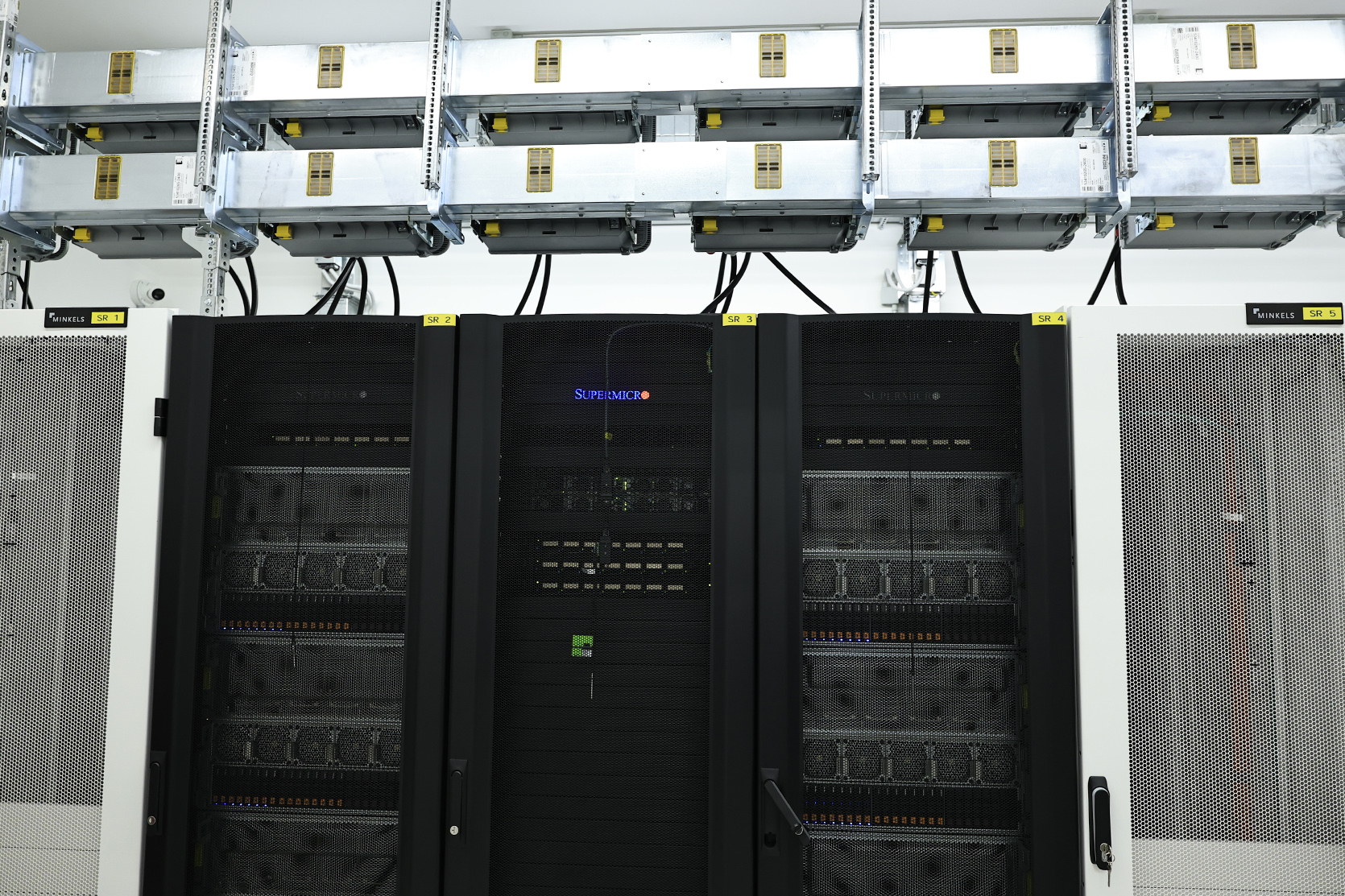
YSU Datacenter has a unified 64-H100 supercomputer, a separate 8-H100 system, and an 8-A100 system. The infrastructure was funded by the Armenian government and is operated primarily for machine learning, computational physics, materials science, and other compute-intensive research.
Armenian scientific teams can receive free or nominal-fee access according to research priority. This makes YSU the country's main public research-compute platform.
The cluster monitoring report records 164,716 allocated GPU-hours from 1 April through 18 August 2026, equal to 79.3% of possible capacity over the reporting window. The denominator assumes 62 H100 GPUs were continuously available. This is an intensity measure, not hardware-level device utilization or computational efficiency.
The system supports fine-tuning, distributed training, hyperparameter studies, and moderate-scale foundation-model research. Its main value is giving Armenian research groups and students sustained access to modern GPUs without requiring commercial cloud budgets.
---
Eleveight AI #
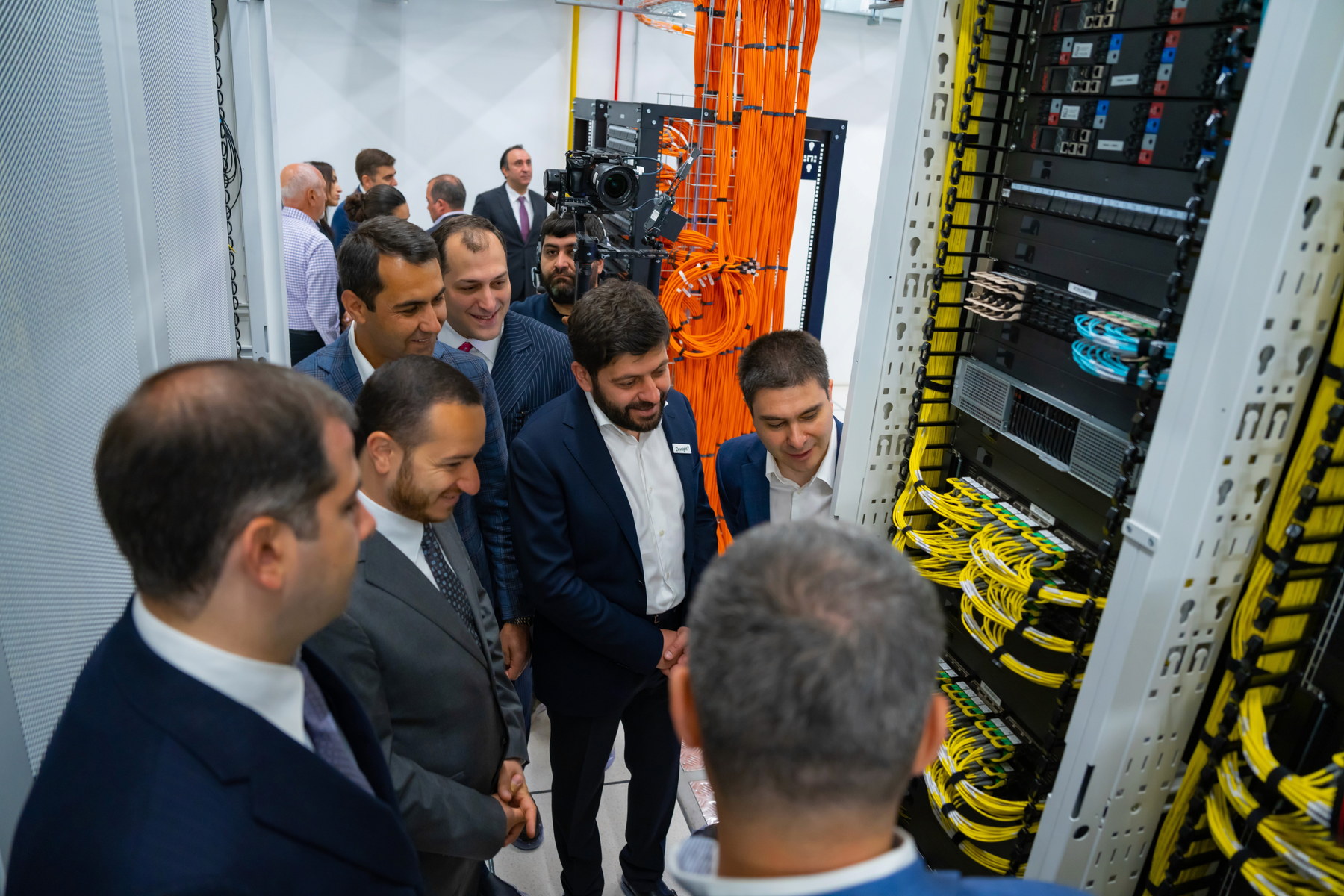
Eleveight AI officially opened its Gagarin AI Factory on 1 June 2026 with 512 NVIDIA B300 GPUs. The company reports a $120 million first-phase investment and says the facility was built to NVIDIA reference-architecture standards.
Most of the initial 512-GPU capacity has been sold. Eleveight AI is targeting another 512 B300 GPUs by January 2027, followed by thousands of NVIDIA Vera Rubin GPUs in late 2027.
Eleveight AI has committed 20% of its compute to Armenian universities, research centers, and nonprofit initiatives. Because most of the current 512-GPU deployment has already been sold, this research allocation will come from future deployments.
The Gagarin location allows natural cooling during most of the year. Eleveight AI also owns solar-generation assets supporting the facility.
---
Firebird AI #
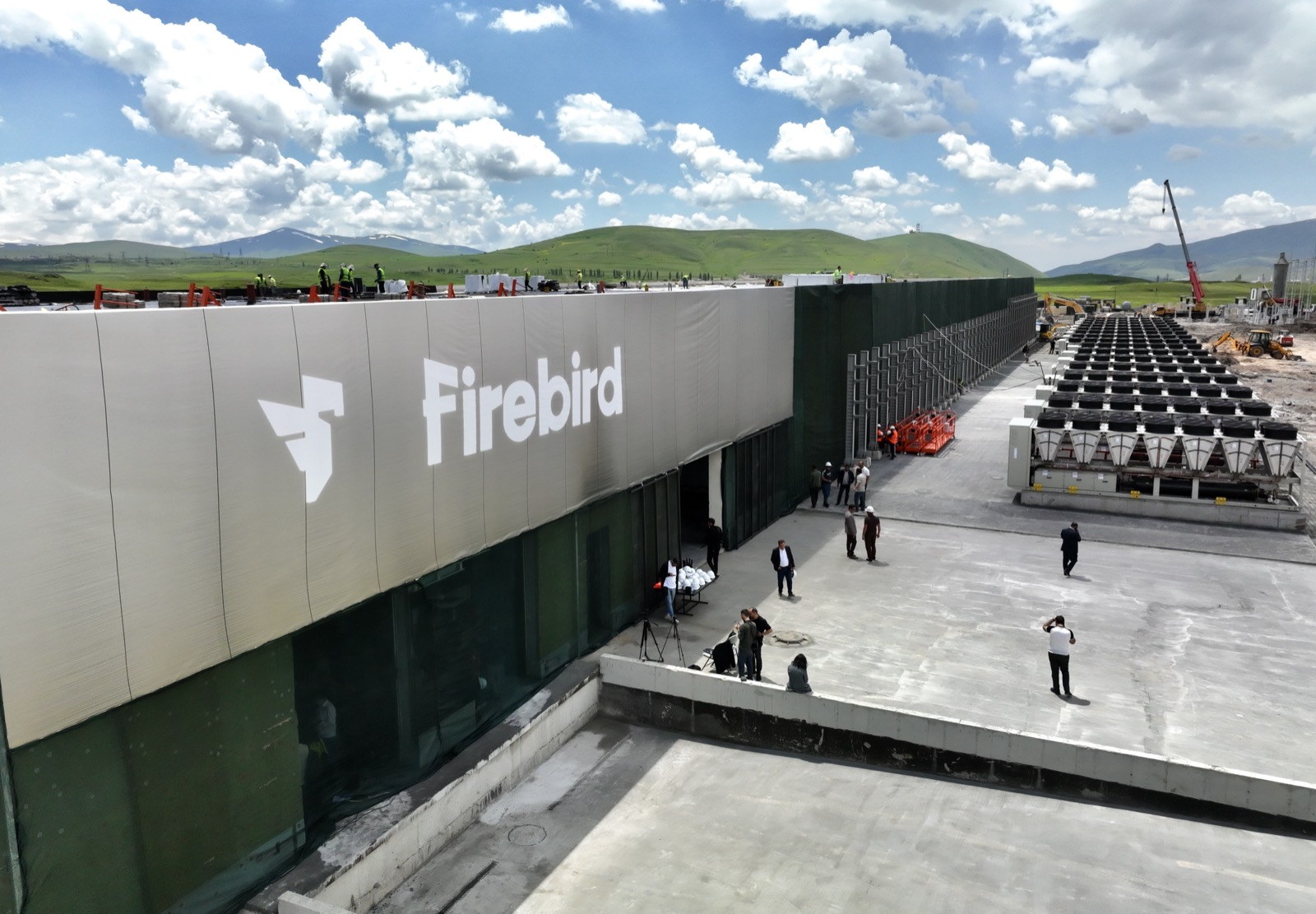
Firebird's AI factory near Hrazdan opened in August 2026 with 6,144 NVIDIA B200 GPUs and 18 MW of power capacity. The company reports up to 110.6 exaflops of FP4 tensor performance; this AI-oriented figure is not directly comparable with the FP64 measurements used to rank conventional scientific supercomputers.
Phase one represents a $500 million investment, including a $300 million syndicated financing package from six Armenian financial institutions. Most of the cluster has been sold to large U.S.-based customers.
The Armenian government has contracted for $25 million of compute over five years, corresponding to roughly 3% of the phase-one cluster. The capacity is intended for startups, research groups, educational institutions, individual specialists, and public-sector projects through the Artificial Intelligence Virtual Institute.
Firebird is targeting 60,000+ NVIDIA Vera Rubin GPUs in summer 2027 for its next expansion phase.
---
Bottom line #
Armenia's compute capacity is growing faster than the local capacity to use it for high-quality research. The country needs more research labs and more ambitious projects to create sufficient demand for this infrastructure.
Government investment in the YSU supercomputer and the Firebird compute contract provides the hardware and access needed for that growth. The main bottleneck is now funding research teams: recruiting and retaining researchers, developing strong projects, and building new labs capable of turning compute into publications, models, scientific results, and companies.
AI Industry
Snapshot: August 2026
Armenia's AI industry is best understood through three forms of economic activity. Some companies sell AI engineering and expertise to clients. Others own products whose value substantially depends on AI. A third group consists of AI teams inside broader companies whose principal business is not itself an AI product or AI consultancy.
Across the three categories, Armenia's strongest visible concentrations are in creative and visual AI, voice and speech, life sciences, enterprise document systems, banking and financial decisioning, advertising and recommendations, applied computer vision, and a growing cluster in robotics and physical AI.
How to read the profiles #
- AI consulting and service providers primarily build AI systems or supply AI expertise for clients.
- AI product companies own products whose value substantially depends on AI.
- AI teams inside broader companies develop or deploy AI within companies whose overall business is broader than AI.
- Tags describe application domains; domains are not used as the primary grouping.
- Armenia briefly states the company's relationship to Armenia: for example, founded or headquartered in Armenia, or an international company with an Armenian branch or team. A remote employee alone does not constitute company presence.
- Where a company has public research covered in the report, its profile includes a sentence describing that work in the AI research chapter.
1. AI consulting and service providers #
Service providers connect Armenia's engineering workforce to international demand. The category includes AI-specialist firms and broader software companies with a material AI practice. Some also maintain reusable products, but client delivery remains central to their public business model.
- Metric combines custom AI development with an AI lab that releases Armenian-language models, datasets and benchmarks. Tags:
Armenian languageNLPretrievalcomputer visionphysical AI. Armenia: Armenia-based company with its research and engineering team in Yerevan. Public research. Metric AI Lab publishes Armenian-language models, datasets and benchmarks and conducts research in retrieval and physical AI.
- Magical Labs is an AI R&D and engineering company that develops model-based products for clients, including the Armenia-built technology behind BandM8 for live audio-to-MIDI conversion and generated musical accompaniment. Tags:
generative musicaudio AIMIDIhuman-AI collaboration. Armenia: Headquartered in Yerevan and operating locally as ML Labs LLC. Research: No.
- Fimetech develops custom agents, fine-tuned models, computer-vision, geospatial and embedded physical-AI systems. The robotics company Getin originated as a Fimetech spin-off and is profiled separately below. Tags:
computer visionphysical AIgeospatial AIembedded AIagents. Armenia: Founded and headquartered in Yerevan, with its engineering team in Armenia. Research: No.
- Labz.ai develops AI products and systems for clients, including LLM applications, fine-tuned models, computer vision, data engineering and edge deployment. Tags:
LLM applicationscomputer visionedge AIdata engineeringAI consulting. Armenia: Founded and headquartered in Yerevan, with its team based at Yerevan State University. Research: No.
- Provectus builds production AI, GenAI, data-platform and MLOps systems for enterprises. Tags:
enterprise AIagents and RAGMLOpsdata engineering. Armenia: US-based company with an engineering hub in Yerevan. Research: No.
- Quantori provides AI, scientific-informatics and software-engineering services to life-science and healthcare organizations, while also developing Q-Suite products. Tags:
life sciencesscientific informaticsdrug discoveryagentic AI. Armenia: US-based company with a large development center in Yerevan. Research: No.
- Improvis provides computer-vision, deep-learning and robotics engineering, including AI target detection and tracking, wide-area surveillance, and autonomous navigation, guidance and control. Tags:
computer visionroboticsphysical AIUAVsautonomous systems. Armenia: Founded and headquartered in Yerevan, with its AI and aerospace engineering team in Armenia. Research: No.
- MPP Labs provides data, analytics and AI/ML services and develops enterprise tools for analytics, OCR and data processing. Tags:
enterprise analyticsOCRtext analyticspredictive ML. Armenia: International company with an R&D center in Yerevan. Research: No.
- Grid Dynamics is a global engineering consultancy with AI, data-science and cloud practices. Tags:
recommendationretail AIenterprise AIMLOps. Armenia: US-based company with an engineering office in Yerevan. Research: No.
- WaveAccess provides custom software, data engineering and AI/ML development. Tags:
custom AIdata engineeringenterprise software. Armenia: International software company with a branch in Yerevan. Research: No.
- DataArt is a broad software-engineering provider with enterprise AI and data-science capabilities. Tags:
enterprise AIdata sciencesoftware services. Armenia: US-based company with an engineering office in Armenia. Research: No.
- EPAM provides enterprise software, data and AI services internationally. Tags:
enterprise AIdata platformssoftware services. Armenia: US-based global company with an engineering office in Armenia. Research: No.
- Noble Scripts provides AI/ML, data-science and software-development services. Tags:
AI consultingdata sciencesoftware services. Armenia: Headquartered in Yerevan, with its delivery team in Armenia. Research: No.
- Zealous (formerly Instigate Mobile) provides custom software and AI/ML development, including frontier-model document systems and custom computer-vision solutions. Tags:
custom AIdocument intelligencecomputer visionenterprise software. Armenia: Founded and headquartered in Armenia, with teams across five Armenian cities. Research: No.
- Instigate Design develops embedded, EDA, high-performance-computing and AI systems, including applied computer vision and AI-accelerated image processing. Tags:
embedded AIcomputer visionsatellite imagerydeveloper tools. Armenia: Founded and headquartered in Yerevan, with an additional engineering branch in Gyumri. Research: No.
- Hylink Technologies provides product R&D in network security, digital identity, embedded systems and data science; its public site explicitly describes creating and maintaining custom ML/DL models. Tags:
digital identitycybersecurityembedded systemsapplied ML. Armenia: Headquartered in Yerevan, with its engineering and research organization in Armenia. Research: No.
- Toptal supplies AI, machine-learning, generative-AI, NLP and MLOps expertise through consulting teams and its global talent network. Tags:
AI consultingmachine learninggenerative AIMLOps. Armenia: Global remote-talent company with multiple current Armenia-linked AI/ML experts in its network; no local office. Research: No.
- SmartCode provides AI and programming education and has public Armenia-linked junior ML engineering profiles; a related Yerevan software-services operation also advertises custom AI development. Tags:
AI educationmachine learningsoftware services. Armenia: Armenia-based organization in Yerevan; the public profiles do not always distinguish training from employment, so the local ML-team interpretation remains qualified. Research: No.
- Armenian Artificial Intelligence Company is a commercial R&D studio providing à-la-carte AI engineering, world modeling and software development while also building internal projects. Tags:
AI R&Dworld modelingsoftware engineeringapplied AI. Armenia: Headquartered in Yerevan, with an Armenia-based research and engineering team. Research: No.
- Akvelon provides AI/ML and software-engineering services across computer vision, NLP, signal processing, anomaly detection and production MLOps. Tags:
AI consultingcomputer visionNLPMLOps. Armenia: US-based engineering company with current Armenia-linked AI engineers; no separate Armenian office was confirmed in this review. Research: No.
- Analysed.ai provides data-science, big-data, mathematical-modeling and software-development services. Tags:
data sciencemathematical modelingLLMsRAG. Armenia: Founded and headquartered in Yerevan, with a local AI/ML engineering team. Research: No.
- Hyperion AI is an AI venture studio that creates products, co-builds AI ventures and helps enterprises develop production AI capabilities. Tags:
AI venture studioproduct engineeringcomputer visionenterprise AI. Armenia: Founded and headquartered in Yerevan, where its engineering leadership is based. Research: No.
- Inferaim provides AI strategy, research, development and integration, with emphasis on generative AI, knowledge graphs and explainable AI. Tags:
generative AIknowledge graphsexplainable AIAI consulting. Armenia: Armenia-linked company with a current Yerevan AI engineer and locally based founders; its public site does not state a formal office address. Research: No.
- Lumiverse / reArmenia provides AI consulting, implementation, workflow automation and education, while developing internal AI learning products. Tags:
AI consultingworkflow automationAI educationagents. Armenia: Armenia-based company headquartered in Yerevan, formerly reArmenia Academy. Research: No.
- Wireless 20/20 provides telecom consulting and WiROI geospatial planning tools that use AI and big-data analytics for broadband deployment and investment decisions. Tags:
telecom analyticsgeospatial AInetwork planningpredictive analytics. Armenia: US-based company with Armenia-linked data-science and software-development personnel. Research: No.
2. AI product companies #
Product companies are the clearest evidence of owned AI-related intellectual property in the ecosystem. Some train or fine-tune important models; others build applications and workflows primarily on external frontier models. Several do both.
- 10Web develops an agentic website-building and management platform. Tags:
website generationAI agentsno-codecontent generation. Approach: Frontier-model user combined with in-house layout and orchestration. Armenia: Founded in Armenia, with its core product and engineering organization in Yerevan. Research: No.
- ActiveCampaign develops marketing automation and its Active Intelligence agentic interface. It acquired Feedback Intelligence in February 2026. Tags:
marketing AIAI evaluationconversational analyticsagents. Approach: Frontier-model user. Armenia: US-based company with an Armenia team formed through its 2026 acquisition of Feedback Intelligence. Research: No.
- Activeloop develops Deep Lake, a database and data infrastructure layer for multimodal AI, vector search, RAG and agent memory. Tags:
AI infrastructuremultimodal datavector searchRAG. Approach: AI infrastructure/model-development boundary. Armenia: US-based company founded by Armenians, with an established technical team in Armenia; a dedicated physical office is not claimed. Public research: Deep Lake has an accompanying systems-research record.
- Aerodynamics develops UAVs and autonomous systems and conducts research combining control theory and artificial intelligence. Tags:
roboticsphysical AIUAVsautonomous systemscontrol. Approach: Model developer. Armenia: Founded in Armenia in 2020 and headquartered in Yerevan, with a local AI engineering team. Research: No.
- Alango Technologies develops embedded speech- and audio-processing software, including deep-neural-network noise reduction and dereverberation. Tags:
speech enhancementaudio AIembedded AIhearing technology. Approach: Model developer. Armenia: International company with an office and a deep-learning and audio-engineering team in Armenia. Research: No.
- Amaros develops a proprietary ophthalmology data and clinical-intelligence platform. Tags:
ophthalmologyclinical AImedical knowledge graphs. Approach: Model developer. Armenia: International company with AI leadership and model development in Armenia. Public research. Amaros AI has published work on using large language models to extract biomedical entities and relations and construct medical knowledge graphs.
- Areg.AI develops a full-stack solar-operations platform combining digital twins, drone diagnostics, predictive maintenance, workflow automation and robotics. Tags:
clean energypredictive maintenancedrone inspectiondigital twinsroboticsphysical AI. Approach: Frontier-model user; current Yerevan recruitment documents RAG, agent orchestration and evaluation work, while proprietary model development is not publicly established. Armenia: Founded and headquartered in Yerevan, with local product development and deployments at Armenian solar plants. Research: No.
- ArmAeroSystems develops UAV platforms and AI-driven swarm-autonomy systems for defense and industrial applications. Tags:
roboticsphysical AIUAVsswarm autonomydefense technology. Approach: Model developer; the company describes adaptive coordination systems that learn from real-world physics simulations. Armenia: Armenia-based company with its embedded software, airframe and autonomy engineering in the country. Research: No.
- ASA / ArmChats is a conversational discovery and ranking platform for finding services, professionals and places in Armenia. Tags:
local searchrecommendationconversational AImultilingual NLP. Approach: Frontier-model user; its public documentation identifies Gemini alongside structured filtering and AI-assisted relevance ranking. Armenia: Developed in Armenia by ArmChats Armenia LLC for the local market. Research: No.
- Async (formerly Podcastle) develops proprietary text-to-speech, voice-cloning and audio-generation models alongside creator tools and a developer API. Tags:
voice AITTSvoice cloninggenerative audio. Approach: Model developer. Armenia: Founded in Armenia, with most of its R&D and operations based in the country. Research: No.
- BeeSync develops beehive monitoring using acoustic sensing, computer vision and predictive analytics. Tags:
AgriTechcomputer visionacoustic sensingIoT. Approach: Model developer. Armenia: Founded in Armenia, with local model development, pilot deployments and hardware assembly. Research: No.
- Blackmar / ARQA develops financial-technology and AI document/workflow products. Tags:
FinTechwealth managementdocument intelligenceAI agents. Approach: Frontier-model user; its public products include AI assistants and document-extraction workflows, with no stated proprietary model development. Armenia: Armenia-based company with its product team in Yerevan. Research: No.
- Boo Vision develops portable ground-surveillance and airborne synthetic-aperture radar products with automatic target detection and classification. Tags:
radarRF sensingedge AIcomputer vision. Approach: Model developer; company-linked researchers have published neural methods for classifying radio-frequency images. Armenia: Founded in Armenia in 2023, with its radar and AI engineering team in Yerevan. Research: No.
- BostonGene develops AI-enabled precision-oncology, multi-omics and digital-pathology systems. Tags:
precision oncologymulti-omicsdigital pathologydrug discovery. Approach: Model developer. Armenia: US-based company with a scientific and AI R&D team in Yerevan. Research: No.
- Chessify provides cloud chess engines and AI-assisted chess analysis. Tags:
chess AIgame analysiscloud computing. Approach: Model developer. Armenia: Founded and developed in Armenia, with its product team in the country. Research: No.
- Cifora develops an Armenian command-and-control platform that integrates operational data, intelligence analysis, secure communications, sensors, UAVs, robotic systems and AI-assisted decision support. Tags:
defense technologycommand and controlgeospatial intelligencecomputer visionphysical AI. Approach: Frontier-model and AI-tool integrator; public evidence does not establish proprietary model development. Armenia: Founded and based in Armenia, with its product team in the country. Research: No.
- Cognaize develops neuro-symbolic and language-model systems for financial documents and decisions. Tags:
FinTechdocument AIknowledge graphsfinancial language models. Approach: Model developer. Armenia: US-based company with a product and engineering office in Yerevan. Research: No.
- Constructor develops an AI-native search, recommendation and product-discovery platform for enterprise e-commerce. Tags:
e-commercesearchrecommendationpersonalization. Approach: Model developer, using reinforcement learning, transformers, LLMs and proprietary ranking systems. Armenia: US-based company with an office and a ranking and machine-learning team in Armenia. Research: No.
- COPA develops source-backed decision-intelligence products for political, regulatory, institutional and operational analysis. Tags:
decision intelligenceGovTechRegTechOSINT. Approach: Both; it owns an adaptable AI architecture while tailoring deployed products to client data and workflows. Armenia: Founded and headquartered in Yerevan, with its AI product team in Armenia. Research: No.
- Criteo develops advertising, recommendation and programmatic-decisioning products that depend heavily on ML. Tags:
AdTechrecommendationrankingprogrammatic advertising. Approach: Model developer. Armenia: France-based global company with a technology hub in Yerevan formed through its acquisition of IPONWEB. Research: No.
- Cyber Fusion develops Ayg, an open, programmable quadruped platform for education, research and robotics applications. Tags:
roboticsphysical AIreinforcement learningeducation technology. Approach: Model developer. Armenia: Founded in Armenia, with most of its team based in the country. Research: No.
- DataFoundry AI develops AI-enabled life-sciences products for pharmacovigilance, drug-safety monitoring, literature review and clinical-trial workflows. Tags:
life sciencespharmacovigilancedocument intelligencehealthcare analytics. Approach: Both, combining SaaS products with data-science services. Armenia: India/US-based company with an office and data-science engineering presence in Yerevan. Research: No.
- Davaro develops and manufactures UAVs, unmanned ground vehicles and other robotic systems, together with AI-powered detection and tracking software. Tags:
roboticsphysical AIUAVscomputer visiondefense technology. Approach: Model developer; its public product material describes machine-learning and deep-learning systems for detecting, classifying and tracking aerial vehicles. Armenia: Founded in Armenia in 2007, with its robotics production and AI engineering in Yerevan. Research: No.
- DCY develops automotive driver-monitoring and sensing technology. Tags:
automotive AIdriver monitoringcomputer visionbiosignals. Approach: Model developer. Armenia: Armenia-based company with its driver-monitoring R&D team in Yerevan. Research: No.
- Deep Origin develops computational-biology, molecular-simulation and AI drug-discovery products. The company merged with Biosim AI and incorporates its Armenia team. Tags:
drug discoverymolecular modelingcomputational biology. Approach: Model developer. Armenia: US-based company with an ML and scientific R&D office in Yerevan, formed through its merger with Biosim AI. Public research. Deep Origin's Armenia team publishes on molecular docking, virtual screening, active learning, molecular-property prediction, and AI agents for drug discovery.
- Denovo Sciences develops generative and predictive AI for drug discovery. Tags:
drug discoverygenerative chemistrymolecular ML. Approach: Model developer. Armenia: Founded in Armenia by a local scientific team. Research: Yes; its publications and research resources are listed on the company's research page and in the research chapter.
- Docus develops AI-assisted health interpretation and clinical/laboratory workflow products. Tags:
healthtechclinical workflowspatient assistance. Approach: Frontier-model user; model provenance should be refreshed periodically. Armenia: Founded by an Armenian team, with product operations in Armenia and abroad. Research: No.
- Firebird develops large-scale AI cloud and computing infrastructure. Tags:
AI infrastructureLLM inferencemodel servingcloud computing. Approach: Frontier-model user, focused on inference serving and optimization. Armenia: US-based company operating an AI factory near Hrazdan and building an AI engineering team in Yerevan. Research: No.
- FiveBrane Labs develops medical-imaging AI infrastructure for dataset auditing, bias detection, clinician collaboration and privacy-preserving remote model training. Tags:
medical imaginghealthcare AIfederated learningdata quality. Approach: Model developer, including its proprietary AIMS data-selection method. Armenia: International company with its principal research and engineering facility in Yerevan. Research: No.
- Getin, a spin-off from Fimetech, develops a hardware-agnostic visual-processing and control platform for ground robotics, including autonomous tracking, edge inference, simulation and integration with third-party robotic hardware. Tags:
roboticsphysical AIcomputer visionedge AIautonomous systems. Approach: Model developer; its current stack includes proprietary vision-action systems, while self-learning physical-AI foundation models are described as a longer-term objective. Armenia: Founded in Armenia as a Fimetech spin-off, with its R&D team in Yerevan. Research: No.
- GOTCHA Technology develops computer-vision systems for recognizing facial micro-expressions, hidden emotions, fatigue and possible deception. Tags:
computer visionemotion AIbehavior analysissafety. Approach: Model developer. Armenia: Founded and headquartered in Yerevan, with its AI and computer-vision team in Armenia. Research: No.
- Hecttor, operated by Saima, develops low-latency speech-rate adjustment, noise cancellation, voice isolation and speech enhancement for contact centers and voice-AI systems. Tags:
speech AIaudio enhancementcontact centersvoice infrastructure. Approach: Model developer. Armenia: Armenia-founded product with its core AI and engineering team in Yerevan, operating locally through Inted CJSC. Research: No.
- HerculesAI (formerly ZERO Systems) develops AI workflow automation for legal and enterprise documents. Tags:
legal AIdocument intelligenceenterprise automation. Approach: Both. Armenia: US-based company with an engineering team in Armenia. Research: No.
- HireBee develops recruiting and applicant-tracking products with AI-assisted matching and workflows. Tags:
HRTechrecruitingcandidate matching. Approach: Frontier-model user. Armenia: Developed by the Yerevan-based staff.am organization, with operations in Armenia and abroad. Research: No.
- hispeech.ai / BlueNeyron develops proprietary Armenian speech recognition, transcription, subtitling and developer APIs. Tags:
Armenian languageASRspeech-to-textAI infrastructure. Approach: Model developer. Armenia: Founded and based in Yerevan, with its own AI infrastructure and data center in the city. Research: No.
- IntelinAir develops agronomic intelligence from aerial imagery and field data. Tags:
AgriTechremote sensingcomputer visionagronomic analytics. Approach: Both. Armenia: US-based company with a longstanding R&D team in Armenia. Research: No.
- Intent.ai develops a privacy-focused programmatic-advertising and subscriber-profiling platform that applies machine learning to telecom data. Tags:
AdTechaudience modelingtelecom analyticsrecommendation. Approach: Model developer. Armenia: US-founded company headquartered operationally in Yerevan, with an AI/ML team and offices in several markets. Research: No.
- Itseez3D / Avatar SDK develops computer-vision systems for 3D avatars, generative video and AR/VR. Tags:
3D computer visionavatarsgenerative videoAR and VR. Approach: Model developer. Armenia: International company with a computer-vision team in Yerevan. Research: No.
- Krisp develops real-time voice AI for noise removal, accent conversion, transcription and conversational workflows. Tags:
voice AIspeech enhancementASRenterprise communications. Approach: Model developer. Armenia: Founded in Armenia as 2Hz, with its core product and voice-model R&D team in Yerevan.
- MAIO / Maio_Armenia develops an enterprise AI voice-automation platform for call centers and financial institutions, combining ASR, TTS, LLM dialogue orchestration and telephony integration. Tags:
voice AIAI agentsASRTTS. Approach: Model developer and frontier-model integrator. Armenia: Armenia-based startup with its team and office in Yerevan. Research: No.
- MathrixAI develops enterprise agents, RAG and computer-vision systems alongside products for elder care and automation. Tags:
AI agentsRAGcomputer visionelder care. Approach: Both. Armenia: International company with a research hub and office in Yerevan. Research: No.
- Megaladata develops a low-code analytical platform spanning data preparation, model training, neural networks, visualization and production integration. Tags:
data analyticslow-codemachine learningdata mining. Approach: Model-development platform. Armenia: Armenian company with its main office and product team in Yerevan. Research: No.
- ModelFront develops machine-translation quality prediction and automatic post-editing. Tags:
machine translationquality estimationlanguage AI. Approach: Model developer, including client-specific fine-tuning. Armenia: International company with a product and engineering team in Yerevan. Research: No.
- NCCAIT develops Armenian-language text-to-speech, automatic speech recognition and neural machine translation. Tags:
Armenian languageTTSASRmachine translation. Approach: Model developer. Armenia: Founded and headquartered in Yerevan as the National Center of Communication and Artificial Intelligence Technologies. Research: No.
- NVIDIA develops foundation models, speech systems, robotics software and AI computing platforms globally. Tags:
foundation modelsspeechlanguage modelsAI systems. Approach: Model developer. Armenia: US-based global company with a research team in Armenia working on language-model and speech programs. Public research. The NVIDIA Armenia research team publishes on language-model reasoning and robustness, Nemotron model development, speech recognition and translation, diarization, and simultaneous speech translation.
- Perceptron AI develops proprietary perception and embodied-reasoning models and an SDK for physical-world applications, including robotics, manufacturing, logistics and security. Tags:
physical AIembodied intelligencevideo understandingspatial reasoning. Approach: Model developer. Armenia: US-based company with technical personnel and research collaborations in Armenia. Research: No.
- PerigonAI combines a geospatial market-intelligence platform with custom analytics and AI engagements. Tags:
geospatial AImobility analyticsforecastingmarket intelligence. Approach: Both. Armenia: US-based company with most of its data-science and product team in Armenia. Research: No.
- Picsart develops creative image and video generation and editing products. Tags:
creative AIcomputer visiongenerative media. Approach: Both. Armenia: Founded in Armenia, with a major product-engineering and research office in Yerevan and offices in several other countries. Public research. Picsart AI Research publishes on generative and discriminative computer vision for image and video creation, editing, segmentation and controllable diffusion.
- Plat.ai develops predictive-analytics and automated-decisioning products. Tags:
predictive analyticsdecisioningFinTech. Approach: Model developer. Armenia: US-based company with an engineering team in Armenia. Research: No.
- Polixis develops RegTech data and products for AML, KYC and compliance and also offers related services. Tags:
RegTechAML and KYCknowledge graphsNLP. Approach: Both, including internally developed language models. Armenia: Switzerland-based company with an R&D hub in Yerevan operating since 2017. Research: No.
- Portmind develops Sail, an agentic trade- and customs-compliance platform. Tags:
trade compliancelogisticsdocument AIrisk modeling. Approach: Both. Armenia: International company with an AI product and engineering team in Yerevan. Research: No.
- Robi Labs develops language, vision and multimodal AI models and products, including agentic software-development and conversational tools. Tags:
multimodal AIAI agentsdeveloper tools. Approach: Model developer. Armenia: Founded and headquartered in Yerevan, with its research and product team in Armenia.
- Scylla develops computer-vision and video-intelligence products for physical security. Tags:
computer visionvideo analyticsphysical security. Approach: Model developer. Armenia: Founded by an Armenian team, with engineering operations in Armenia and offices abroad. Research: No.
- Softr develops a no-code platform with prompt-generated applications, workflows and AI components. Tags:
no-codeapplication generationworkflow automation. Approach: Frontier-model user. Armenia: Germany-based company with a product and engineering branch in Armenia operating as Brainbees Solutions. Research: No.
- SuperAnnotate develops data-curation, annotation, evaluation and fine-tuning infrastructure. Tags:
AI dataannotationevaluationfine-tuning infrastructure. Approach: Both; its core product enables other model developers rather than being a foundation model. Armenia: Founded in Armenia, with a major product and R&D office in Yerevan and offices abroad. Research: No.
- Toxometris.ai develops in-silico and hybrid in-silico/in-vitro systems for toxicity and drug-safety assessment and also offers related services. Tags:
computational toxicologydrug safetymolecular ML. Approach: Model developer. Armenia: International company with biological and machine-learning researchers in Armenia. Public research. Toxometris researchers publish on computational toxicology, molecular representations, QSAR modeling, and toxicity and carcinogenicity prediction.
- Unum develops high-performance vector-search and AI data infrastructure. Tags:
vector searchAI infrastructuredata systems. Approach: AI infrastructure/model-development boundary. Armenia: Registered in Armenia. Research: No.
- Uray Technologies develops photonics and AI-enabled diagnostic systems, including automated urinalysis. Tags:
MedTechoptical diagnosticsphotonicsIoT. Approach: Model developer. Armenia: Armenian medical-technology startup based in Yerevan. Research: No.
- WAV develops Armenian speech recognition, speech synthesis and voice-agent components. It originated as a spin-off from the Center for Advanced Software Technologies (CAST). Tags:
Armenian languageASRTTSvoice agents. Approach: Model developer. Armenia: Founded in Armenia as a CAST spin-off, with its team in Yerevan. Research: No.
- Webb Fontaine develops trade and customs platforms using AI for classification, valuation, document extraction, fraud and risk detection, clearance prediction and natural-language interfaces. Tags:
GovTechcustomsdocument AIfraud detectiontrade analytics. Approach: Both model developer and frontier-model user. Armenia: International company with a major product R&D center in Yerevan. Research: No.
- Yandex Armenia develops search, recommendation, language and other machine-learning systems. Tags:
searchrecommendationlanguage modelsconsumer AI. Approach: Model developer. Armenia: International technology company with an office, ML staff and education programs in Armenia. Research: No.
- Yerevan Aerospace Engineering develops UAV platforms, avionics, secure communications and autonomous-system integrations. Tags:
roboticsphysical AIUAVsautonomous systemsdefense technology. Approach: Not verified; the company publicly presents Nemesis AI as an autonomous interceptor UAV concept, but does not yet document the underlying model stack or deployment status. Armenia: Founded and based in Armenia, with its UAV and communications engineering and manufacturing in the country. Research: No.
- Zoomerang develops an AI-enabled mobile and web platform for video and photo creation, including restyling, text-to-image, generative fill and AI effects. Tags:
creative AIgenerative mediavideo editingcreator tools. Approach: Frontier-model user; no public evidence of a proprietary foundation model was found. Armenia: Founded in Armenia in 2018, with its product and engineering team in Yerevan. Research: No.
3. AI teams inside broader companies #
These teams are important to Armenia's labor market and model-development capacity, but their parent companies should not be counted as AI-native companies. Their total Armenia headcount is not a proxy for AI headcount.
- Philip Morris International maintains a substantial Armenia data-science team developing internal models. Tags:
enterprise data scienceinternal AI. Armenia: US-based multinational with a data-science and model-development team in Armenia. Research: No. Arnak Poghosyan's VMware-era publications are not attributed to PMI.
- ServiceTitan develops software for the trades, with AI work spanning document retrieval, catalog matching, job scoping, recommendation and price estimation. Tags:
enterprise softwaredocument AIrecommendationpricing. Armenia: US-based company with a large engineering office and an AI team in Yerevan. Public research. ServiceTitan Armenia publishes applied work on visual document retrieval and collaborates with AUA on NLP, job scoping, price estimation and proposal generation.
- SoftConstruct operates central AI and data teams supporting gaming and enterprise businesses. Tags:
gamingenterprise AIanalytics. Armenia: Founded in Armenia, with central AI and engineering teams in Yerevan and offices in several other countries. Research: No.
- Ameriabank develops in-house machine-learning systems for lending, behavioral and investment decisions, together with model validation, monitoring and explainability infrastructure. Tags:
bankingcredit modelingdecisioningmodel risk. Armenia: Armenia-based bank with data-science and model-risk teams in Yerevan. Research: No.
- Ardshinbank develops and deploys in-house AI/ML models for banking products, including credit scoring, recommendation, NLP and generative-AI applications. Tags:
bankingcredit modelingrecommendationNLPgenerative AI. Armenia: Armenia-based bank with a data-science and machine-learning team in Yerevan. Research: No.
- Inecobank develops machine-learning credit-risk and scoring systems, including model training, validation, backtesting and monitoring. Tags:
bankingcredit riskscoringmodel validation. Armenia: Armenia-based bank with a risk-policy and model-development team in Yerevan. Research: No.
- Acba Bank operates a dedicated AI and machine-learning department that develops in-house models for credit decisions, document processing, sales and customer advisory. Tags:
bankingcredit decisioningdocument AIcustomer analytics. Armenia: Armenia-based bank with a dedicated AI and machine-learning team in Yerevan. Research: No.
- Fast Bank develops in-house predictive and AI/ML systems for customer lifecycle management, personalization and recommendations, supported by production data pipelines and real-time inference. Tags:
bankingrecommendationcustomer analyticsMLOps. Armenia: Armenia-based bank with a data-science team in Yerevan. Research: No.
- Evocabank develops applied machine-learning systems for customer segmentation and banking analytics, with internal model validation and monitoring. Tags:
bankingcustomer segmentationclusteringmodel monitoring. Armenia: Armenia-based bank with a data-science team in Yerevan. Research: No.
- IDBank develops in-house statistical and machine-learning models for credit-risk scorecards, behavioral modeling and customer segmentation. Tags:
bankingcredit riskbehavioral modelingcustomer segmentation. Armenia: Armenia-based bank with an internal risk-modeling team in Yerevan. Research: No.
- Synopsys Armenia develops EDA and semiconductor software that increasingly incorporates AI/ML. Tags:
semiconductorsEDAAI-assisted design. Armenia: US-based global company with a major engineering center in Armenia. Research: No.
- AMD / Xilinx develops semiconductor hardware and design software, including ML-assisted FPGA tooling. Tags:
semiconductorsFPGAEDA optimizationAI infrastructure. Armenia: US-based global company with a Yerevan engineering team working on Vivado and ML-assisted FPGA tooling. Research: No.
- Adobe develops creative and enterprise products with generative and agentic AI. Tags:
generative mediamarketing technologyenterprise agents. Armenia: US-based global company with a Yerevan engineering office contributing to Workfront and GenStudio. Research: No.
- Aderant develops business-management software and AI products for law firms, with work in Armenia spanning LLM evaluation, fine-tuning, training-data generation and model deployment. Tags:
legal technologyLLMsmodel evaluationfine-tuning. Armenia: US-based company with an AI and data-science presence in Armenia. Research: No.
- Wolfram develops computational-intelligence and technical-computing products, including the Wolfram Language and machine-learning capabilities. Tags:
computational intelligencemachine learningtechnical computingdeveloper tools. Armenia: US-based company with an office and a machine-learning and data-science team in Armenia. Research: No.
- Align Technology develops digital-dentistry and orthodontic products. Tags:
digital dentistry3D computer visionmedical imagingpredictive modeling. Armenia: US-based global company with a Yerevan scientific and engineering office working on 3D vision and clinical systems. Research: No.
- Digitain develops sportsbook and iGaming platforms with AI-powered recommendations, RAG, speech processing, text classification and fraud-detection applications. Tags:
iGamingrecommendationNLPfraud detection. Armenia: Founded and headquartered in Yerevan, with a local innovation, AI and data team. Research: No.
- WorldQuant applies data science and machine learning to quantitative investment research and operates the BRAIN research platform. Tags:
quantitative financemachine learningpredictive modelingresearch platform. Armenia: US-based quantitative-investment firm with an office and a quantitative-research and data-science team in Armenia. Research: No.
- ATG CJSC / Engineering City develops microwave equipment, antennas, electronics and full-cycle engineering systems, with local ML engineering and AI-agent activity. Tags:
microwave engineeringembedded systemscomputer visionAI agents. Armenia: Armenia-based Engineering City resident with its engineering and manufacturing team in Yerevan. Research: No.
- Teza Technologies is a systematic trading firm whose AI group develops LLM, neural-network and machine-learned market-signal systems. Tags:
quantitative financedeep learningLLMspredictive modeling. Armenia: US-based firm with an office and a quantitative-research team in Armenia. Research: No.
- ACRA Credit Reporting operates Armenia's credit-reporting and scoring infrastructure and has a current local data-science function. Tags:
credit reportingcredit scoringfinancial analyticsdata science. Armenia: Armenia-based credit bureau headquartered in Yerevan; the exact production ML scope is not publicly documented. Research: No.
- ClinChoice provides clinical-research, biometrics and data services and has a current Armenia-linked AI/ML team lead. Tags:
clinical researchbiometricsclinical dataapplied ML. Armenia: International clinical-research organization with an office and an AI/ML team in Armenia. Research: No.
- ClinStatDevice provides clinical-trial consulting, biometrics, data analytics and proprietary monitoring software that includes machine-learning and AI methods. Tags:
clinical trialsbiometricshealthcare analyticsapplied ML. Armenia: International clinical-research company with a current Armenia-linked AI/ML engineer; no local office. Research: No.
- HelpSystems Armenia / Fortra develops enterprise automation and cybersecurity software, with current Armenia-linked ML, NLP and data-engineering personnel inherited from the HelpSystems organization. Tags:
cybersecurityenterprise automationNLPdata engineering. Armenia: International enterprise-software company with a HelpSystems-branded technical presence in Armenia. Research: No.
- Locator CJSC develops electronics and software for vehicle tracking, telemetry, smart-city control and security systems and maintains a local computer-vision and ML function. Tags:
computer visionembedded AIsmart citytelemetry. Armenia: Founded and headquartered in Yerevan, with local electronics, software and machine-learning engineering. Research: No.
- VMware / Broadcom Armenia develops cloud, virtualization and enterprise infrastructure software, including an increasingly AI-native VMware Cloud Foundation stack. Tags:
cloud infrastructurevirtualizationprivate AImachine learning. Armenia: US-based global company with an established Yerevan engineering office and current local ML engineering evidence. Research: No.
Borderline cases #
The boundary between categories 2 and 3 depends on whether AI is central to the product's value, not on company size or whether the company also sells conventional software.
- Criteo, BostonGene and Zoomerang are product companies because ML or generative AI is central to the product itself.
- ServiceTitan is placed under broader companies because it has a substantial AI program, but its overall product and business are not best described as an AI company.
- NVIDIA is an AI product company despite its breadth because AI models, software and computing platforms are central to its current business and to the Armenia team's work.
- Quantori, Fimetech, Metric, MPP Labs and MathrixAI combine services and products. They are placed according to their dominant public market position, with the secondary model noted in the description.
- SuperAnnotate, Unum and Firebird are product companies at the industry/infrastructure boundary: their products help other teams build or operate AI. Firebird's local AI engineering team is only beginning to form.
- Cyber Fusion is a product company at the industry/infrastructure boundary: Ayg is a physical platform for robotics development, while the public evidence for proprietary AI models remains limited.
- Semiconductor and EDA teams such as AMD, Microchip and Synopsys belong here only for locally performed AI development; their hardware role belongs primarily in the infrastructure chapter.
The Role of Government
Snapshot date: August 2026
Two ministries have the principal roles in Armenia's AI ecosystem. The Ministry of Education, Science, Culture and Sport of the Republic of Armenia is responsible for education and the public research system; through the Higher Education and Science Committee, it funds research groups and scientific equipment. The Ministry of High-Tech Industry and Artificial Intelligence of the Republic of Armenia leads AI industrial policy, access to commercial compute, support for technology companies, and the emerging use of AI in public services. Other public bodies are beginning to use and regulate AI, but activity outside these two ministries remains comparatively limited.
The government's roles can therefore be understood as research funder, infrastructure buyer, education-system coordinator, ecosystem builder, regulator, and user of AI.
Ministry of Education, Science, Culture and Sport #
The Ministry also sets higher-education policy, including program classification, licensing and accreditation, and supports knowledge and technology transfer through HESC.
Research funding through the HESC #
The Ministry's Higher Education and Science Committee (HESC) oversees public policy and funding for higher education and research. Most HESC grants are competitive programs open across scientific fields rather than dedicated AI funding lines. AI and machine-learning groups nevertheless receive substantial support when their proposals succeed in these general competitions.
The table below contains the clearly AI/ML-related research awards identified in HESC result orders published from 2020 through August 2026. It excludes projects classified only as “possible” AI, as well as two 2026 professional-training awards that are not research grants. English titles are translations or normalized renderings of the public annex titles. Blank funding cells indicate that the cited public award record did not state an amount.
#### AI/ML-relevant HESC research grants
| Code | PI | Host | Title (in English) | Funding | Source |
|---|---|---|---|---|---|
20TTAT-AIa014 | Arnak Poghosyan | NAS RA Institute of Mathematics | Machine-learning-enhanced predictive analytics for cloud data centers | Official order | |
20TTAT-AIa024 | Hrant Khachatryan | YerevaNN Scientific-Educational Foundation | Research on semi-supervised learning algorithms | Official order | |
20TTAT-QTa003 | Armen Allahverdyan | A. Alikhanyan National Science Laboratory | Quantum information and machine learning: general approaches and tools | Official order | |
20TTAT-RBe016 | Vahagn Poghosyan | NAS RA Institute for Informatics and Automation Problems | Fault-tolerant monitoring and task-execution software for a self-organizing UAV swarm using collective AI | Official order | |
20TTCG-1F004 | Nelly Babayan | NAS RA Institute of Molecular Biology | Deep-neural-network in-silico prediction of small-molecule metabolism and toxicity | Official result | |
21T-2B195 | Marinka Baghdasaryan | National Polytechnic University of Armenia | Electromagnetization-control-system model based on an artificial neural network | Official order | |
21T-2B002 | Vazgen Melikyan | National Polytechnic University of Armenia | AI integrated circuits and their design tools | Official order | |
| N/A | Azatouhi Ulikyan | National Polytechnic University of Armenia | AI-controlled bionic upper limb and exoskeleton: adaptive multivariable control systems | Official result | |
21SC-BRFFR-1B009 | Hrachya Astsatryan | NAS RA Institute for Informatics and Automation Problems | Remote-sensing processing for pollution prediction using neural networks and deep learning | Official result | |
21AG-1B052 | Hrachya Astsatryan | NAS RA Institute for Informatics and Automation Problems | Intelligent cloud platform for a self-organizing UAV swarm using multi-agent algorithms | Official result | |
21T-5B128 | Gayane Harutyunyan | National Defense Research University | AI and future wars: guidelines for Armenia's defense industry | Official appeal order | |
22AA-1E021 | Grigor Ayvazyan | NAS RA Center for Ecological-Noosphere Studies | Natural-pasture change using remote sensing and machine learning | Official result | |
22RL-052 | Theofanis Raptis / Hrant Khachatryan | Yerevan State University | Domain Shift for Machine Learning in IoT Applications (DISTAL) | Official result | |
22RL-012 | Hayk Khachatryan / Arsen Sahakyan | NAS RA A. Nalbandyan Institute of Chemical Physics | AI model for next-generation perovskite solar-cell and display materials | Official result | |
23RL-1B028 | Denis Turdakov / Tsolak Ghukasyan | Armenian-Russian University | Natural Language and Speech Processing Laboratory | Official result | |
23DP-2B024 | Marine Mikilyan | NAS RA Institute of Mechanics | 3-D moving-object localization using machine learning and numerical methods | Official result | |
23AA-5B013 | Gyulnara Danielyan | Public Administration Academy | Prospects for an innovative AI-based defense industry in Armenia | Official result | |
23LCG-1C004 | Narek Sahakyan | ICRANet-Armenia | Multi-messenger and multi-wavelength blazar study: a machine-learning approach | Official result | |
23LCG-1C011 | Gevorg Qaryan | A. Alikhanyan National Science Laboratory | Tau physics and new-particle searches at Belle II using ML algorithms | Official result | |
24AA-1C039 | Mher Khachatryan | ICRANet-Armenia | Blazar studies using machine learning | AMD 6.4m | Official result |
24AA-1F030 | Arpine Minasyan | NAS RA Institute of Molecular Biology | Molecular subtyping of leukemia and myeloma by integrating transcriptomics and ML | AMD 9.6m | Official result |
24FP-1A058 | Hrant Khachatryan | Yerevan State University | Language Models for Molecule Generation | AMD 54m | Official result |
24RL-1B049 | Naira Hovakimyan / Vahan Huroyan | Yerevan State University | Vision-Language Foundation Models for Aerial Robotics | AMD 130m | Official result |
24LCG-1E008 | Gevorg Tepanosyan | NAS RA Center for Ecological-Noosphere Studies | Geochemical characterization using compositional-data analysis and machine learning | AMD 153m | Official result |
24DP-2B004 | Vazgen Melikyan | National Polytechnic University of Armenia | ML-based visual localization, tracking, and trajectory-prediction hardware/software tool | AMD 40m | Official result |
25SC-CNR-1B006 | Hrant Khachatryan / Theofanis Raptis | Yerevan State University / CNR-IIT | DeepRF: deep-learning RF localization and mapping with synthetic data | AMD 5m Armenian allocation | Official result |
25SRNSF-1B022 | Hasmik Sahakyan / Vakhtang Kvaratskhelia | NAS RA Institute for Informatics and Automation Problems / Georgian partner | Machine-learning theory and convergent applications | AMD 4m Armenian allocation | Official result |
25RG-1B142 | Hayk Aslanyan | Armenian-Russian University | Compiler optimization-flag selection using machine learning | AMD 22.5m | Official result |
25RG-2B089 | Armine Avetisyan | National Polytechnic University of Armenia | Machine-learning design of electromagnetic devices for robotic systems | AMD 22.5m | Official result |
25RG-2B096 | Marinka Baghdasaryan | National Polytechnic University of Armenia | Machine-learning diagnosis and fault prediction for electromechanical converters | AMD 22.5m | Official result |
25RG-2B002 | Vazgen Melikyan | National Polytechnic University of Armenia | ML-based chiplet-interconnect design methods and tools | AMD 22.5m | Official result |
25EDP-1B030 | Karen Avetisyan | NAS RA Institute for Informatics and Automation Problems | Code-analysis-augmented agentic LLMs for performance optimization with logic preservation | AMD 29.98m | Official result |
25EDP-1F027 | Smbat Gevorgyan | Denovo LLC | HADES AI platform for predictable drug design | AMD 30m | Official result |
25DD-1B082 | Hrant Khachatryan | Yerevan State University | In-context and few-shot change detection in satellite imagery | AMD 30m | Official result |
25DD-1B035 | Ashot Harutyunyan | NAS RA Institute for Informatics and Automation Problems | Land-cover change from aerial imagery using vision foundation models | AMD 30m | Official result |
Grant funding summary. Since 2020, HESC has funded 35 clearly AI/ML-related research projects. Public award records state funding for 16 of them, totaling AMD 611.98 million.
These awards demonstrate recurring support for AI research through HESC's general competitions. HESC does not normally run AI-specific grant programs. One exception was the November 2020 topical award order, which covered artificial intelligence and data science, quantum technologies, and robotics and funded four projects with explicit AI/ML content.
Research computing and equipment #
HESC is also a direct buyer of public research infrastructure. The government's 2026-2030 science and technology priorities record Yerevan State University's acquisition of an eight-GPU NVIDIA DGX A100 system in 2023 and an eight-GPU NVIDIA DGX H100 system in 2024. YSU describes both systems as part of its Data Processing Center and available for scientific and applied work, including machine learning, in its overview of the center.
The largest investment is YSU's 64-H100 supercomputer. In 2024, the government directed AMD 3.4 billion to establishing the YSU supercomputing center. The system is intended primarily for AI and machine-learning groups, while researchers in other computational fields may also apply for access.
Strategy and research priorities #
HESC's usual grant programs are topic-neutral or broadly multidisciplinary. The 2024 perspective-research call, for example, named AI and data science as one of six broad umbrellas rather than establishing an AI-only competition.
A more explicit shift came with the government's January 29, 2026 decision on science and technology development priorities. It ranks artificial intelligence and machine learning as the sole P1 field, the category assessed as having the highest readiness and requiring immediate action. The decision calls for additional funding from 2027 for priority fields, including research capacity, infrastructure, human resources, and international cooperation.
The Ministry's role in school AI education #
The Ministry's distinctive contribution to school AI education is system integration: approving curricula, coordinating participating public schools, recognizing electives, and setting teacher policy. Delivery and financing often involve nongovernmental or private partners, so these programs should not automatically be described as fully state-funded.
The main advanced pathway is the Generation AI High School Program, developed and financed by FAST and partners but delivered through public schools with Ministry cooperation. The Ministry's 2025/26 update reported about 1,000 students in 26 schools across all regions, and its first-graduation report recorded 207 graduates from the original 14 pilot schools.
The Ministry has also approved the partner-developed STEP.ai elective sequence through grades 10–12, as shown by the official curriculum approval, and a ministerial order effective August 14, 2026 added introductory AI applications and appropriate use to the mandatory grade 10 Digital Literacy and Computer Science curriculum. These measures show the government's curricular role without repeating the broader education chapter's program-level detail.
Ministry of High-Tech Industry and Artificial Intelligence #
The Ministry of High-Tech Industry and Artificial Intelligence leads AI industrial policy and deployment. It received its current name through an August 27, 2026 amendment.
Public access to AI compute #
The Ministry launched the Artificial Intelligence Virtual Institute in 2025 as an application and collaboration platform for startups, researchers, companies, and other AI innovators. Its operational 2026 pilot provides fully subsidized high-performance computing through Amazon Web Services to eligible Armenian residents, resident companies, and individual entrepreneurs. Government Decision No. 1966-N defines eligible resources and the application process, but no complete public beneficiary, allocation, or utilization ledger has been published.
In April 2026, the Ministry signed a five-year, $25 million compute agreement with Firebird AI, following Government Decision No. 450-A. The capacity is intended for AI specialists, researchers, education institutions, startups, and public-sector projects through AIVI.
Support for private AI infrastructure #
The Ministry supports the privately owned Firebird and Eleveight facilities through procurement, memoranda, strategic partnership, and international facilitation. The Prime Minister's account of Firebird's August 2026 opening identifies the government's compute purchase, while the Ministry's account of export-license discussions records its facilitation role.
At Eleveight's June 2026 opening, the Ministry signed a memorandum covering support for startups and research teams, skills, high-performance computing, applied AI pilots, public-administration use cases, and cloud services. The Ministry's announcement also records Eleveight's commitment to allocate up to 20% of future compute to Armenian universities, research centers, and nonprofit initiatives. This allocation has not yet been distributed.
The government has no equity stake in either company. Its role consists of procurement, cooperation, and facilitation.
General R&D and startup incentives #
Armenia's topic-neutral R&D tax regime can benefit AI companies. The Ministry's official application guidance explains the qualification process, while its tax-benefit guidance describes the 10% income-tax rate for employees on formally qualified research and experimental-development projects, together with business tax and depreciation benefits. Qualification is assessed by an expert committee chaired by HESC. AI work can qualify when it constitutes genuine R&D; ordinary software development or use of AI does not qualify automatically.
The Ministry also runs general technology-startup programs that include AI companies. Its three-year Plug and Play partnership provides incubation and acceleration, and the third 2026 cohort included explicitly AI-focused startups.
AI in public services #
The Ministry's public-sector AI role remains early-stage. Its August 2026 activity summary said that a concept for AI use and regulation in public administration had been developed and that a separate AI office would follow legislative changes. The published Ministry structure still listed the Digitalization Department and no separate AI office. The accurate description at the cutoff date is therefore a planned AI office, not an established operating unit.
One project under design is a unified AI call-and-chat center for state and local-government services. The Ministry's project notice describes Armenian- and English-language chatbots, a voice agent, live operators, and an administrative system. Official material documents consultation and design, not a completed procurement or nationwide service.
AI use and governance across the wider government #
Outside the two lead ministries, the strongest operational examples are targeted deployments rather than a government-wide AI transformation. The World Bank's GovTech AI repository classifies the State Revenue Committee's Tax AI system as implemented and describes machine-learning use for anomaly and fraud detection, audit planning, document extraction, and draft summaries. A May 2025 implementation account still called it a pilot, so status should be dated and no revenue impact claimed without a published evaluation.
The Government–UNDP National SDG Innovation Lab created AI4Mulberry to classify citizen correspondence in the government's Mulberry document-management system. A UN results report states that the tool reduced the time needed to read and categorize digital correspondence by 99.7%. It is best described as a joint Government–UNDP tool rather than a wholly state-funded system.
Armenia adopted a targeted AI-specific media rule in 2026. The National Assembly's adoption notice covers disclosure of qualifying synthetic audiovisual content, and Commission Decision No. 75-N implements the notice “Created by AI.” This is a synthetic-media labeling rule, not a comprehensive horizontal AI law.
Armenia also signed the Council of Europe Framework Convention on Artificial Intelligence in January 2026 but had not ratified it by the cutoff date, according to the Council of Europe treaty status. The Armenia–United States AI and Semiconductor Innovation Partnership provides a separate framework for AI applications, workforce development, research, infrastructure, secure supply chains, and export-control cooperation. Neither agreement is, by itself, a funded domestic program.
Several initiatives remain in the pipeline. The State Revenue Committee and World Bank began market engagement for a customs AI/ML system, while the Ministry of Finance has discussed an AI pilot for treasury analytics. These indicate growing demand inside government, not widespread deployment.
Overall picture #
Armenia's AI support is concentrated in two ministries: the Ministry of Education, Science, Culture and Sport, principally through HESC, funds research and public computing infrastructure, while the Ministry of High-Tech Industry and Artificial Intelligence supports commercial compute and leads industrial policy. HESC has funded at least 35 clearly AI/ML-related projects since 2020, but expanding stable research laboratories will require larger and more sustained investment. Public-sector AI adoption remains fragmented and will require common standards, coordination, and systematic identification of suitable use cases.
AI Community
Snapshot: August 2026
Armenia's AI community is organized through a small number of recurring conferences, specialist online groups, reading groups, build sessions, hackathons, and company-hosted technical meetups. These activities connect researchers, engineers, students, founders, and people entering the field, complementing the country's formal education and research institutions.
Major recurring conferences #
DataFest Yerevan #
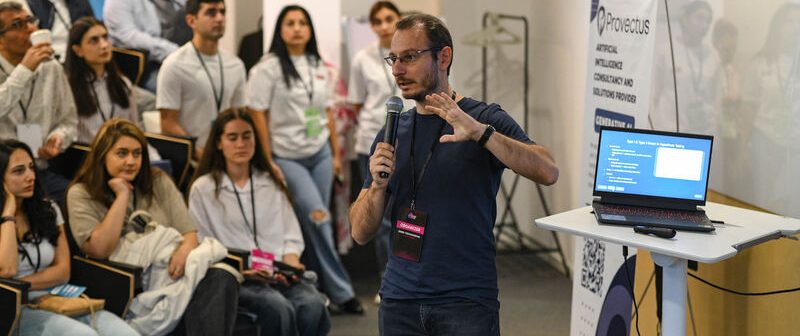
DataFest Yerevan is an international conference on machine learning, with a strong emphasis on engineering and practical applications. It began as an online event in 2020 and subsequently became a recurring in-person gathering for Armenia's AI and data-science community. Its editions were 2020, held online on September 10–12; 2021, held September 10–11 at the American University of Armenia; 2022, held September 2–3 at AUA; 2023, held September 8–9 at AUA; 2024, held September 6–7 at Woods Center, with talk recordings available online; and 2025, held September 12–13 at Woods Center, whose agenda covered research, applied ML, infrastructure, and industry across three halls and whose talk recordings are also available online.
DataFest primarily targets AI researchers and engineers. Its program is highly technical and is designed to advance attendees' knowledge by connecting Armenia's AI community with state-of-the-art research, engineering methods, and production experience.
Representative talks from the 2025 program include:
- Augustin Žídek: “The Hidden Gems in AlphaFold 3.”
- Sayan Ranu: “Learning to Compute Graph Similarity Using LLM-generated Code.”
- Mikhail Burtsev: “GENA-LM: A Family of Open-source Foundational DNA Language Models.”
- Erik Arakelyan: “Compressing LLMs — The Good, the Bad, and the Ugly.”
AI Conf Armenia #
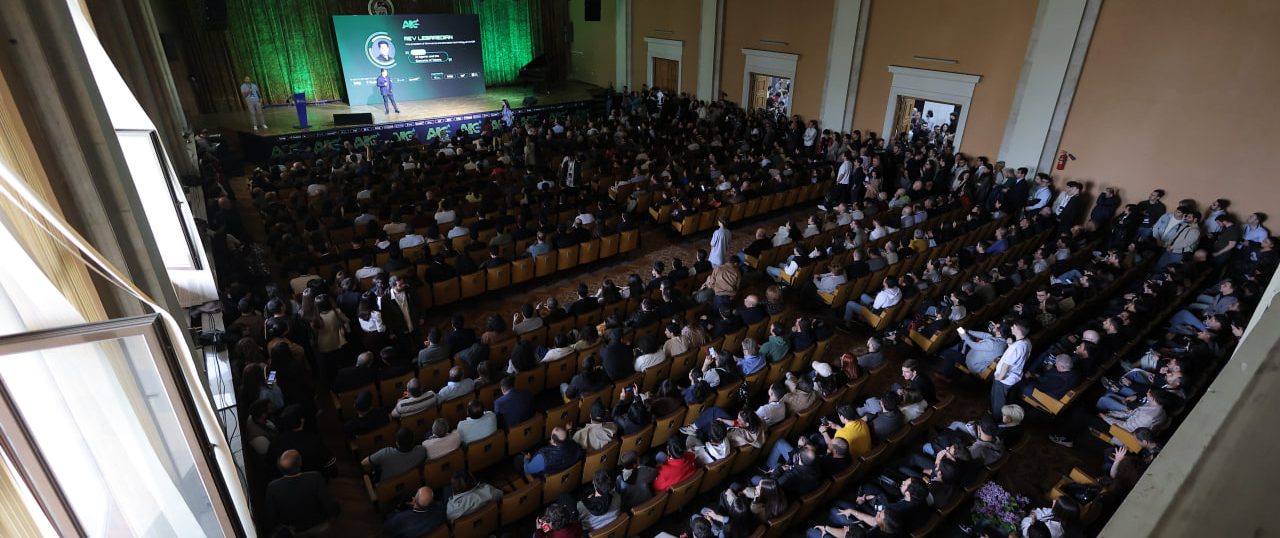
AI Conf Armenia is a conference centered specifically on artificial intelligence. It has held four editions:
- AI Conf Armenia 2022 — June 25 at Yerevan State University. Krisp and YSU initiated the first edition alongside the opening of their joint AI laboratory.
- AI Conf Armenia 2023 — June 23 at YSU, covering the opportunities and risks created by the rapid development of AI.
- AI Conf Armenia 2024 — October 12 at the Sundukyan National Academic Theatre, under the theme “Building with AI.”
- AI Conf Armenia 2026 — April 18 at YSU. The fourth edition focused strongly on GPU-based computing, AI infrastructure, research, and applications, and was organized by YSU, Krisp, UATE, and YerevaNN.
AI Conf addresses a wider audience than DataFest, with a particular focus on students and people considering entering the field. Its goal is to make current AI opportunities visible and motivate students to study AI, pursue research, and take advantage of Armenia's growing computing and institutional capacity.
Representative talks and sessions from the 2026 program include:
- Rev Lebaredian: “AI Agents and the Economy of Tokens.”
- Hrant Khachatrian: “From Molecules to Robots: Training AI for the Physical World.”
- Armen Aghajanyan: “The Armenian AI Doctrine.”
- Vazgen Mikayelyan: “How LLMs Are Redefining Speech Recognition.”
- CS Education after Coding Agents: a panel on how AI coding tools are changing computer-science education.
PyData Yerevan #
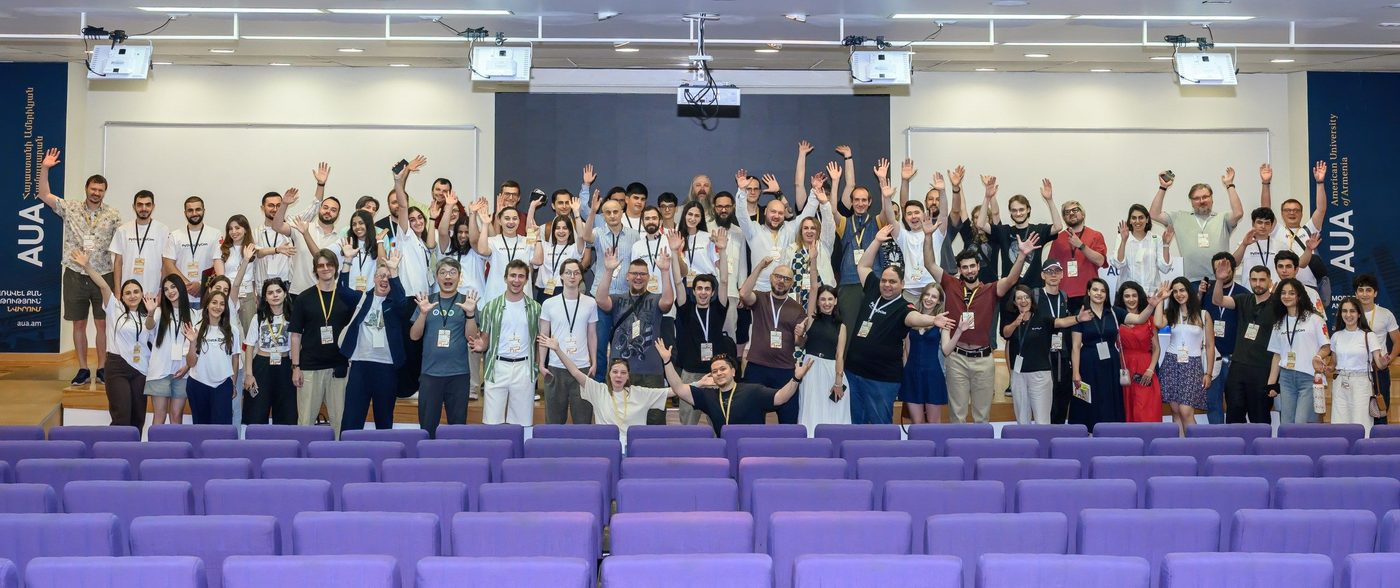
PyData Yerevan connects Armenia to the international PyData and Python communities. Its first edition was held on August 12–13, 2022 at the American University of Armenia. The conference returned on July 24–25, 2026 as PyData & PyCon Yerevan, again hosted at AUA.
PyData Yerevan initially served a broad data-science audience, including analysts, data engineers, statisticians, Python developers, and machine-learning practitioners. Its program has increasingly shifted toward AI, while retaining the wider Python and data ecosystem: the 2026 edition combined PyData and PyCon in Armenia for the first time, with more than 30 speakers from Armenia and abroad across two parallel tracks. The PyData track covered machine learning, AI, analytics, data engineering, visualization, and statistics; the PyCon track covered Python libraries and tools, software engineering, testing, security, and production applications. The program combined keynotes, technical talks, practical case studies, research presentations, Q&A sessions, and community networking. It was organized by AUA's Akian College of Science and Engineering in collaboration with the global PyData and Python communities.
PyData Yerevan has also organized smaller community activities between conferences. In June 2024, it held an open-source pandas sprint at AUA, where newcomers received hands-on guidance for making their first contribution to the widely used Python data-analysis library.
Women in Data Science Armenia #
Women in Data Science (WiDS) Armenia, organized by the Enterprise Incubator Foundation as part of the international WiDS network, has brought together women working in data science, AI, machine learning, research, and technology entrepreneurship. Its recent editions were held on March 13, 2021 at Vanadzor Technology Center; May 21, 2022 at Gyumri Technology Center, with more than 150 participants and a focus on data science for sustainable development; June 28, 2023 at Gyumri Technology Center, under the theme “Creative Cognition”; and May 31, 2024 at Engineering City, alongside the opening of the Armenian National Supercomputing Center, with sessions spanning biology, biomedicine, physics, mathematics, and engineering.
WiDS Armenia targets women at different stages of the data-science and AI pipeline, from students and newcomers to researchers, engineers, and technology entrepreneurs. It is notable for extending professional data-science community activity beyond Yerevan through its editions in Vanadzor and Gyumri.
Yandex Hall machine-learning meetups #
Yandex Hall, opened in Yerevan in 2024, is a public venue for technical communities. Its machine-learning program includes ML OpenTalks organized with the YerevaNN community, broader Yandex Armenia AI events, and applied ML and data-engineering meetups.
The machine-learning meetups primarily target researchers and practicing ML engineers. They are technically focused, generally assume prior familiarity with machine learning, and are not designed as broad introductory events.
ML OpenTalks have included:
- Philipp Guevorguian: “How We Trained an LLM to Enhance Molecular Optimization Algorithms.”
- Hakob Tamazyan: “ECCV Insights and Computer Vision Foundation Models.”
- Sara Vera Marjanović: “Thoughtology: Patterns in LLM Reasoning.”
- Hrant Khachatrian: “Scaling Laws.”
- Perouz Taslakian: “Enterprise Visual Understanding with Vision-Language Models.”
- Vladislav Savinov: “Speeding Up Training with FP8 and Triton.”
- Vaagn Toukharian: “AI Security and LLM Agents.”
- Menua Bedrosian: “TokenFlow: Unified Image Tokenizer for Multimodal Understanding and Generation.”
Yandex Hall also hosts broader AI meetups and applied-ML sessions, including events on physical AI, LLM evaluation, road safety, and industrial diagnostics.
These meetups provide a recurring, lower-barrier format between the country's larger annual conferences and give local researchers and engineers a place to discuss individual papers, systems, and practical experience.
Hack-Nation Global AI Hackathon #
TUMO Labs hosted the Yerevan hub of Hack-Nation's Global AI Hackathon twice in 2026. The April edition brought together approximately 100 local participants, and 17-year-old Daniel Hakobyan from Vanadzor won one of the global challenge tracks. The July edition involved 48 participants in Yerevan as part of a global event with more than 2,000 participants.
Hack Armenia #
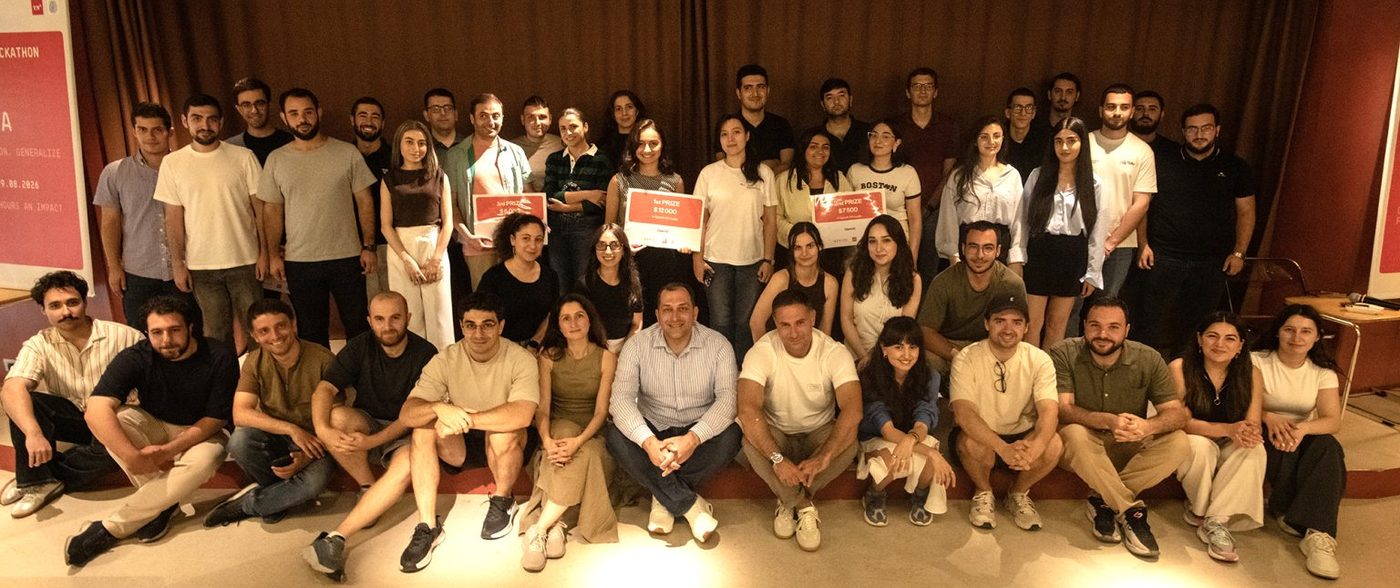
Hack Armenia was a 24-hour AI hackathon held at AI9 Startup Campus on August 8–9, 2026. Participants built solutions to a common LLM evaluation and reasoning challenge in mentored teams and presented them to an expert jury. The event was open beyond the participants of the preceding LLM Summer School and was organized by AI9 Startup Campus, the Armenia LLM Summer School, and YerevaNN.
AI workshops in broader developer communities #
GDG Yerevan includes AI in its broader developer-community program. Recent AI-focused events include:
These workshops primarily target software developers who want practical experience integrating frontier-model tools and agentic systems into applications, rather than researchers seeking research-level presentations.
- IWD 2025: Redefine Possible — Build with AI, with talks on AI, ML, data, and women shaping the field.
- Build with AI: AI-Powered Frontends, a February 2026 workshop using Angular and Google's Agent Development Kit.
- Build Multi-Agent AI Systems on Google Cloud, a June 2026 hands-on workshop at Yandex Hall covering agent orchestration, memory, context, RAG, Vertex AI, and deployment.
Community groups and communication channels #
- ML EVN is a broad Yerevan machine-learning community with a resource directory. Its Telegram group is used for technical discussion, event announcements, opportunities, and questions across research and applied ML.
- Natural Language Processing in Armenia brings together computer scientists, linguists, data scientists, businesspeople, and others interested in NLP in Armenia. It has an invitation-based Telegram group as well as a Facebook group; access to the Telegram group is listed through the ML EVN directory.
- Agentic EVN is a Telegram community focused on AI agents, AI-assisted software development, and “vibe coding.” It reflects the recent growth of practitioner communities built around frontier-model applications rather than conventional ML alone.
- Vibe Coding with AI, previously called AI Yerevan, organizes recurring work sessions where participants use AI tools to build demos, prototypes, and personal projects. The series reached its 50th session in May 2026 and maintains a Telegram channel.
- AI Collective Yerevan launched its local chapter with a community kick-off in February 2026. Its formats include small meetups and hands-on events, such as the OpenClaw workshop held in March 2026.
- ODS Yerevan is a Yerevan offshoot of the Russian Open Data Science community. It provides a local discussion space for data science and machine learning. It is distinct from DataFest Yerevan; the wider ODS community has also held its own events in Armenia, including an offline day of ODS Data Fest 2023 at Russian-Armenian University.
- Machine Learning Reading Group Yerevan holds regular paper discussions and open technical talks. Its 2026 program includes discussions of new model releases and presentations by Armenia-based researchers.
- BioML EVN is a specialist community focused on machine learning in biology and biomedicine.
Role of community activity in the ecosystem #
Verified summary. The community layer is concentrated in Yerevan but spans both research-oriented and practitioner-oriented activity. DataFest Yerevan, AI Conf, and PyData & PyCon Yerevan provide large public gathering points; ML EVN and specialist online groups sustain communication between events; and reading groups, ML OpenTalks, build sessions, open-source sprints, and hackathons support continuous technical exchange.
Even so, the overall event density remains low, at roughly one event per month, apart from the regular journal clubs at YSU.
AI Literacy
Snapshot: August 2026
> AI literacy is not AI education. In this report, AI education means developing the mathematical, computational, and research skills required to understand or build AI systems. AI literacy means learning to use existing AI products effectively, critically, safely, and responsibly. The programs below are listed for reference and are not evidence of Armenia's capacity to train AI engineers, researchers, or model developers.
Armenia has a growing market for short courses that introduce generative-AI tools to professionals, educators, students, and the general public. These programs range from broad introductory courses to role-specific training in research, content creation, marketing, teaching, automation, and organizational workflows.
Providers and programs #
Lumiverse (formerly reArmenia Academy) #
Lumiverse is a prominent specialized provider of AI-literacy and workplace-adoption courses in Armenia. Formerly known as reArmenia Academy, it offers Armenian-language programs for individuals, educators, businesses, universities, and public institutions.
Its principal public program, AI Qez Ban, currently offers three online formats:
- Start: three classes, six hours, completed in one week;
- Level-Up: six classes, twelve hours, completed in three weeks; and
- Bundle: nine classes, eighteen hours, completed in four weeks.
The courses cover the basic operation and limitations of large language models, prompting, information retrieval, content and presentation generation, image and video tools, no-code website creation, workflow automation, and simple AI agents. Lumiverse also offers role- and organization-specific training, including AI literacy for staff and leaders, customized workplace programs, and an AI for Teachers course developed with the M.A.M Educational Movement. The second AI for Teachers cohort launched in 2026 as a four-week program for teachers in Armenia and the diaspora and received endorsement from Armenia's Ministry of Education, Science, Culture and Sport.
Education export. In February 2026, Lumiverse began delivering its AI-literacy curriculum in India with the ai4abillion initiative and Bharatiya Vidya Bhavan. The first ten-weekend certificate course completed its first cohort, covering practical AI use for varied professional backgrounds. Lumiverse reports a Net Promoter Score above 80. A second hybrid weekend cohort started on June 6. Although still modest in scale, this is a concrete early example of an Armenian organization exporting AI-literacy education with international partners.
Lumiverse reports more than 12,000 learners trained across its activities.
Armenian Code Academy #
Armenian Code Academy provides structured AI-literacy and workplace-adoption training. Its organizational portfolio includes company-wide training in effective prompting, output verification, and data-safety rules; programs tailored to specific teams and workflows; and one-month, profession-specific ACA X tracks. ACA describes its organizational method as an audit followed by training and a capstone project, with attention to depersonalization, zero-data-retention practices, prevention of unapproved “shadow AI” use, and internal AI-usage policies.
ACA X is designed to integrate AI into existing professional workflows rather than teach the mathematics or engineering of AI systems. Its four-week sequence moves from relevant AI fundamentals to tools and workflows, a real workplace project, and implementation. Tracks offered or announced in 2026 cover product and project management, data analytics, software engineering, quality assurance, human resources, recruitment, product design, marketing, and founders. Tuition is AMD 100,000 and is advertised as fully refundable through Armenia's education tax-refund mechanism for participants who complete all four stages and submit a final project.
ACA reports 157 participants across 13 applied “AI in …” groups launched in 2026. These include AI in Product Management (three groups, 46 participants), AI in Data Analytics (two groups, 28), AI in Recruitment (two groups, 21), AI in Software Engineering (one group, 18), and single groups in AI in Human Resources (11), AI in IT Project Management (11), AI in Product Design (11), AI in Marketing (6), and AI for Founders (5). A fourteenth applied group, AI in Quality Assurance, was scheduled for September 2026 and was still accepting applications in August.
ACA reports delivering organizational programs across banking, pharmaceuticals, government, international organizations, and universities. One public example is the Artificial Intelligence Literacy course delivered jointly with Yerevan State University in 2026 for professionals from fields including linguistics, Oriental studies, mathematics, and programming. It introduced AI tools, their ethical and academic boundaries, and principles for selecting and applying them in different domains; participants developed practical projects such as educational games and an AI-assisted platform for Armenian folktales.
In August 2026, ACA reported delivering a one-day AI Literacy Workshop for UNFPA Armenia's functional teams in gender and community engagement, youth and communications, operations, monitoring and evaluation, and program delivery. Working in small groups, participants practiced advanced prompting, built custom assistants for workflows such as monitoring reports and youth outreach, generated presentations and visual materials, and studied data-safe use. The workshop included pre- and post-assessment and produced a reusable prompt library for the organization.
ACA also offers AI Navigator, a free two-week online orientation requiring approximately four hours per week. It introduces beginners to AI concepts and applications and helps them assess how the field could fit their work or future learning.
FAST literacy and teacher-development initiatives #
- DLCS teacher-development pilot. In 2026, FAST and UNICEF, in cooperation with MESCS and with EU support, piloted professional development for Digital Literacy and Computer Science teachers in Kotayk, covering algorithmic thinking, Scratch and Python, AI literacy, and project-based learning.
- NEST Mass Education pilot. Under the Ministry of High-Tech Industry and UNDP's NEST initiative, FAST is implementing a 15-week digital- and AI-literacy program for approximately 200 Grade 10 students in Armavir, Shirak, Lori, and Kotayk.
- AI Tools for Teachers. FAST reports that it is the local technical implementation partner for an EU-supported initiative preparing 60 trainers from 47 mentor high schools to deliver a 25-hour AI-literacy program to 1,200 public-school teachers. The project includes an Armenian-language teacher toolkit and a teacher hackathon.
ARDI Academy #
ARDI Academy offers short professional courses on the use of generative-AI products. Its four-week AI Full Course 2026 covers ChatGPT, Claude, Gemini, Copilot, NotebookLM, ChatPDF, Midjourney, and related systems, as well as prompting, context design, AI-assisted research, document analysis, and content generation. The program is primarily practical workforce upskilling rather than technical machine-learning education.
Enterprise Incubator Foundation: AI4ALL #
The Enterprise Incubator Foundation (EIF) launched AI4ALL — Artificial Intelligence for Everyone in 2024 with support from USAID's Armenia Workforce Development Activity. The Armenian-language initiative brings practical AI training to students, educators, and professionals in Yerevan and the regions through courses and workshops.
AI4ALL formats have included AI with project management, marketing with AI, graphic design with AI, programming with AI, and training for educators. EIF reports more than 1,000 students and educators reached, including more than 85 AI-and-project-management graduates, more than 197 graphic-design-and-AI students, more than 447 marketing-and-AI participants, and 287 educators. In one regional example, approximately 100 young people in Shirak joined one-month Programming with AI and Graphic Design with AI workshops at the Gyumri Technology Center. In 2026, EIF also ran an AI4ALL Youth Chapter through its regional centers for participants aged 14-18, covering how AI works, research with AI tools, critical thinking, ethics, and responsible use.
National access initiative: ChatGPT Edu #
In May 2026, Armenia's Ministry of Education, Science, Culture and Sport, OpenAI, and Firebird announced a national initiative to provide approximately 50,000 free ChatGPT Edu and Codex subscriptions to Armenia's educational community from the beginning of the 2026-2027 academic year. The initiative covers schools and universities and is intended for students, teachers, university faculty, and researchers. Firebird is financing access during the first academic year; possible government financing will be considered after the program's implementation and educational impact are evaluated.
Implementation planning began in June with OpenAI and seven Armenian universities, including discussions of institutional responsibilities, technical deployment, training, responsible use, and an implementation roadmap. At this scale, the initiative is expected to enable many students in Armenia to use ChatGPT more regularly and effectively by reducing the access barrier and placing the tool within a supported educational environment.
What these programs show #
The range and geographic reach of these initiatives indicate substantial demand for practical AI-tool skills. They also show that Armenian-language instruction is available for several audiences, including teachers and regional youth. AI penetration in Armenia remains relatively low, however, which leaves substantial market potential for expanded literacy education programs.
Overall Assessment
Armenia has all the main components of an AI ecosystem: academic and industrial research, technical education, AI companies and teams, professional communities, public support, and modern computing infrastructure. These components are substantive rather than merely aspirational, but they differ sharply in scale and maturity and are not yet connected into a uniformly strong system.
What the ecosystem shows #
Research capacity is real but concentrated. Armenia has identifiable groups producing peer-reviewed research, models, datasets, benchmarks, and open technical work. A wider scientific layer applies machine learning in fields such as physics, materials, astronomy, biology, medicine, and autonomous systems. Yet internationally visible core-AI output still depends on a small number of groups and experienced supervisors.
The commercial landscape is broader than the public research landscape. Armenia supports three distinct forms of industry activity: AI consulting and engineering services, companies that own AI-dependent products, and AI teams inside broader companies. Model development is visible across speech, creative media, life sciences, computer vision, document intelligence, recommendation systems, financial services, and physical systems. Only a minority of these teams publish research, so publication counts capture one important layer of industry rather than its full technical capacity.
The talent base is broader than the map of companies with Armenian offices. Many AI specialists living in Armenia work remotely for foreign companies that have no office or legal presence in the country. Toptal is the largest visible concentration of this pattern, connecting multiple Armenia-based AI and ML experts to international clients and teams. These specialists belong to Armenia's workforce and professional community, but their foreign employers should not be counted as companies present in Armenia.
Education offers several entry routes, but the advanced end remains narrow. Students can enter through multi-year school programs, university degrees, professional courses, research groups, and selective summer schools. The main constraint is no longer the absence of introductory opportunities; it is the limited supply of advanced supervision, doctoral specialization, and sustained environments in which students can become internationally competitive researchers and model developers.
Compute has moved from a scarcity story to a utilization story. YSU provides public research capacity, Eleveight operates private Blackwell infrastructure with a future local allocation, and Firebird operates a much larger commercial platform that includes government-contracted capacity. The significance of this build-out will depend on who can use the systems, at what cost, with what support, and what research, products, companies, and public services result from that use.
The ecosystem is connected socially but fragmented institutionally. Conferences, reading groups, meetups, summer schools, and specialist online communities connect researchers, engineers, students, and founders. Government programs support research, education, compute, startups, and selected public-sector applications. However, access rules, outcome data, research capacity, and program ownership remain distributed across institutions, while most activity is concentrated in Yerevan.
The central question is therefore how effectively Armenia converts one form of capacity into another: education into advanced talent, compute into research and products, service experience into owned technology, and globally connected remote expertise into stronger local teams and institutions. Physical AI is a notable opportunity at this intersection because Armenia already has activity spanning robotics, autonomy, perception, embedded systems, and AI infrastructure, although the companies and research groups involved are still small in number.
Anonymous engagement analytics
This reader uses a random browser-tab session identifier, not a person identifier. It records a content block only after it has been visibly on screen for two continuous seconds in an active tab, and estimates visible time while the tab is active and the reader is not idle. We do not use fingerprinting or retain raw IP addresses in the report analytics. Delivery can be blocked or lost; these figures are estimates of engagement, not proof that a person read a passage.
Could not load the original-layout PDF. The web edition remains available.